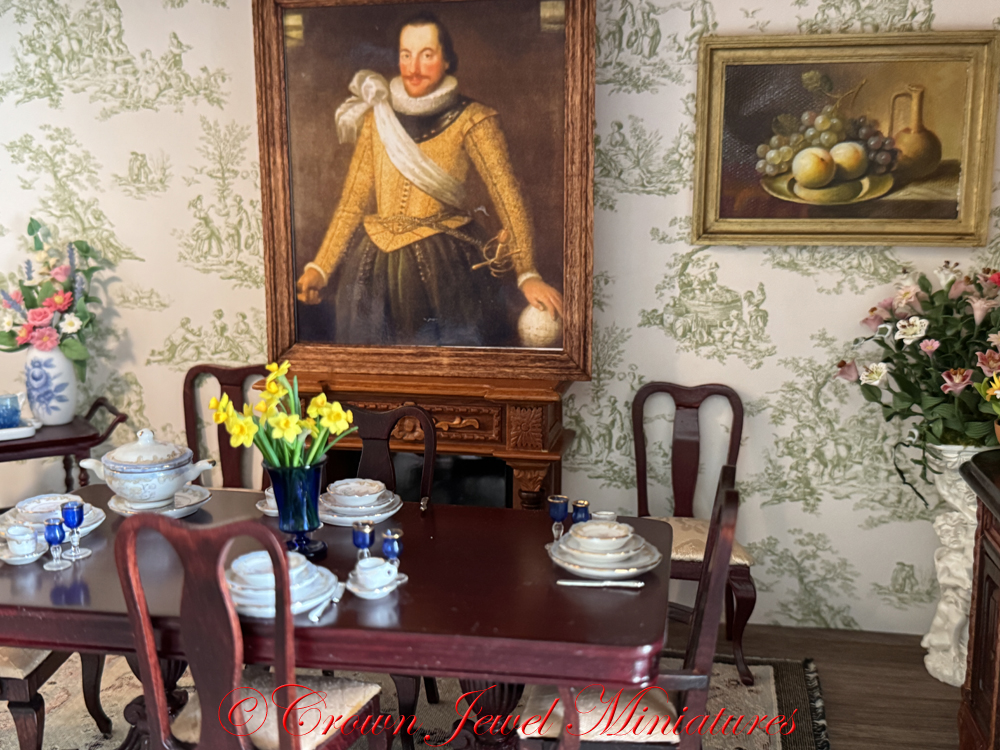
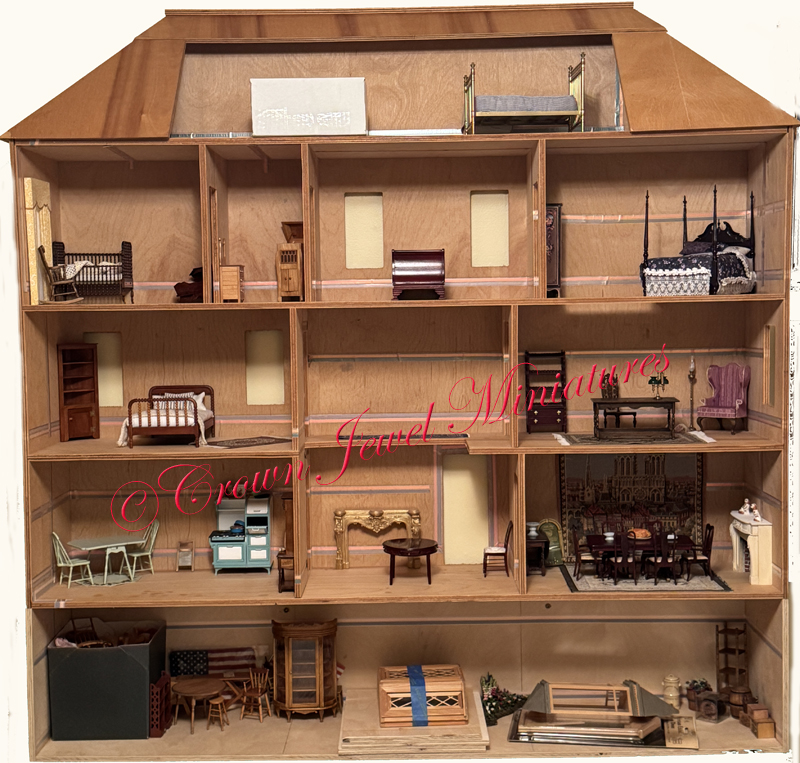
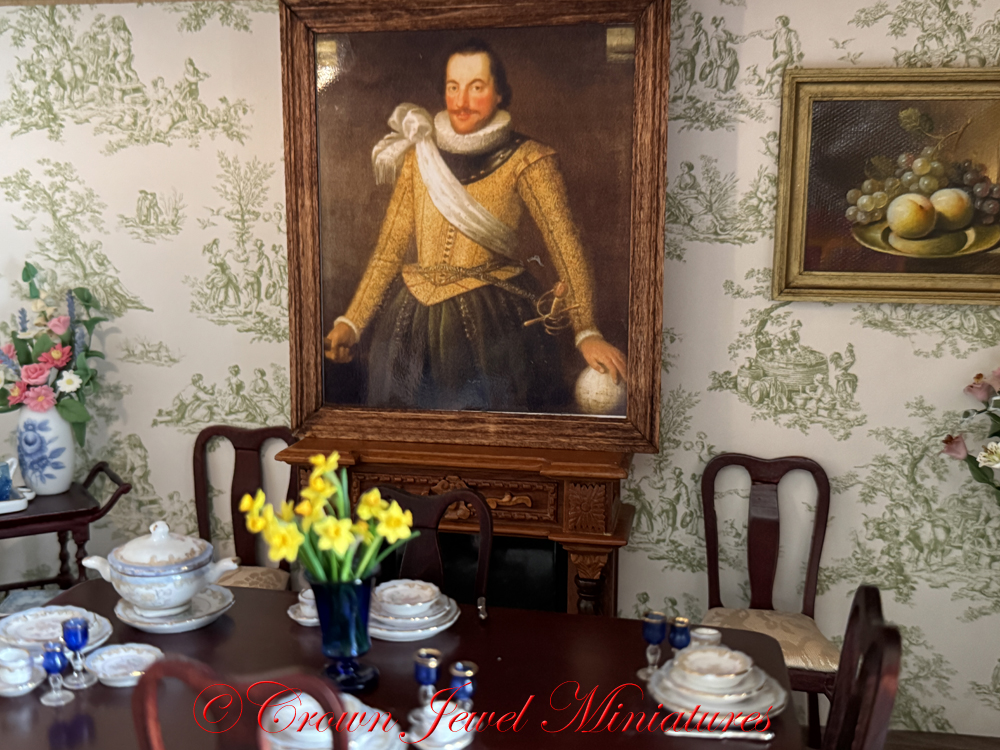
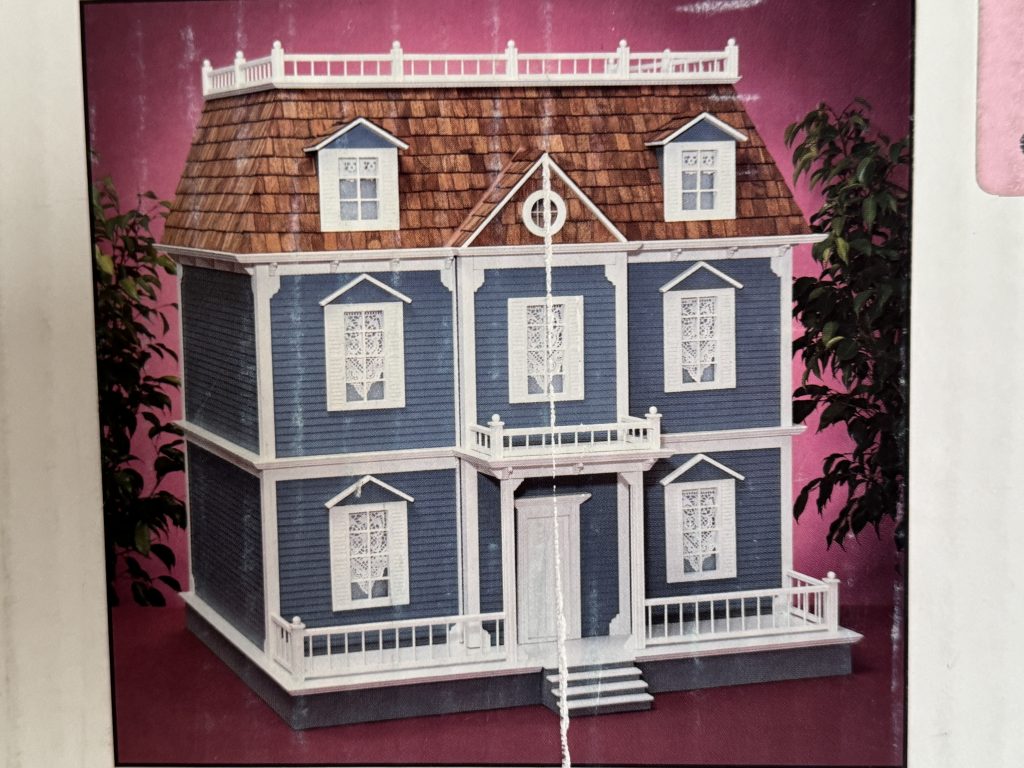
Exciting news in the Crown Jewel Imaginarium! Last year I acquired a large wall house, The Fitzwilliam, made by Earth and Tree Miniatures with the intent to create a quaint English house. I purchased the Fitzwilliam pre-built, knowing it would require various modifications to help transform it into an English house. First, I envisioned mullioned windows and I was thrilled when friends at Earth and Tree Miniatures agreed to custom build two, 3-story bay window additions – one for each side of the house! Not only will this expand six rooms (3 rooms on each side) and open them up, visually, it will add some much-needed character to the exterior. The additions have now been built and next we begin cutting the walls to accommodate them.
The Fitzwwilliam kit by Earth & Tree Miniatures. Walls and doors will be moved and walls will be inserted to create 3 rooms in the attic and 3 rooms in the basement. Currently the house is storing random miniatures and dollhouse furniture, most which will not be used in this collection. Why do new builds always make the perfect catch-all?
So why am I writing this when I don’t yet have much to show?
A new build is always exciting and I had a small idea of the general direction I wanted to take this in… a trug of fresh cut flowers from the garden, a wine cellar and a grandfather clock in the hall… just a quaint, charming English house… but a major discovery this week in my family tree has inspired me (again!) to sail this ship on an entirely different course. Now it is personal!
Admiral Sir Thomas Button was born in Glamorganshire, Wales to Miles Button, a Welsh Sheriff and Justice Of The Peace and Margaret (nee Lewis) Button. Sir Thomas married Lady Mary Ann Price and had quite a storied naval career which you can read all about on WikiTree, Westminster-Abbey.org, The National Library of Wales and Wikipedia if you like, but the abbreviated version is this:
In 1612-13 Thomas Lewis Button commanded an expedition dispatched to inquire into the fate of Henry Hudson and to search for a north-west passage to Asia and had command of two ships, HMS Discovery and HMS Resolution. He is credited with exploring and claiming the west coast of Hudson Bay for England, naming the area New Wales. He and his crew were among the first recorded Europeans to explore part of what is now known as Manitoba. His explorations paved the way for Luke Fox and Thomas James’ subsequent explorations.
In 1614 Button was appointed Admiral of the Irish naval station under orders to combat piracy. In January 1615 he assisted in the recapture of Dunaverty and his bravery under fire earned the admiration and attention of The Crown at the recommendation of Ireland’s lord deputy in 1616.
When Robert Mansell was tasked with ridding the Algerian coast of pirates, he asked Admiral Sir Button to leave his posting on the Irish coast. Button was appointed Rear Admiral of the small fleet, again distinguishing himself in bravery under fire, for which he received a commendation, one of the few officers to gain credit during the unsatisfactory expedition. For most of his career Button was Admiral of the Narrow Seas, that is the Bristol Channel and the whole of Southern Ireland. In recognition for his exploration of and claim of Hudson Bay, bravery and leadership in captaining a ship conveying munitions and stores from Dublin to forces besieging Kinsale and successfully blockading the harbor there, he was knighted by James I.
I have yet to decide which generation will now reside in the home. The home itself will be time-worn and charmingly aged to reflect its illustrious ancestor but also contemporary enough to comfort its descendants with modern conveniences like electricity, plumbing and a pair of green Wellies by the door.
This is going to be fun! Not as momentous as exploring new lands, protecting ships and coastal communities from pirates or acts of gallantry during the bombardment of Rincorran Castle but with Admiral Sir Thomas Button as my inspiration and his blood in my veins, this ought to be interesting! Interesting indeed.
FOR SALE. Contact me via my website email on this site.
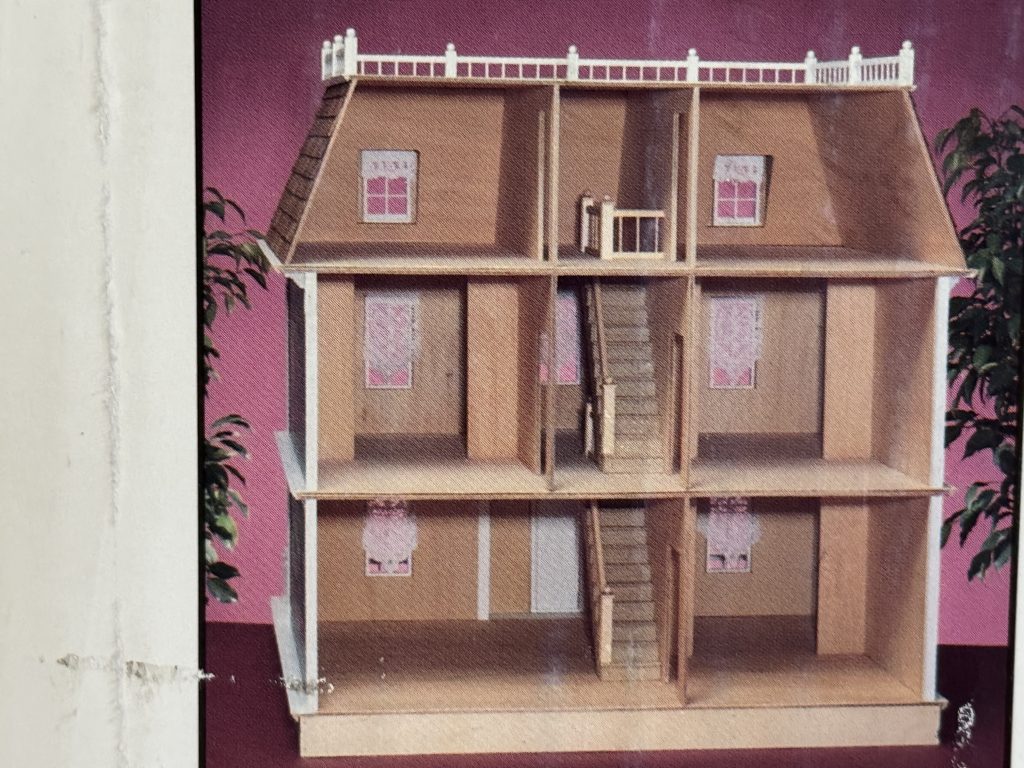
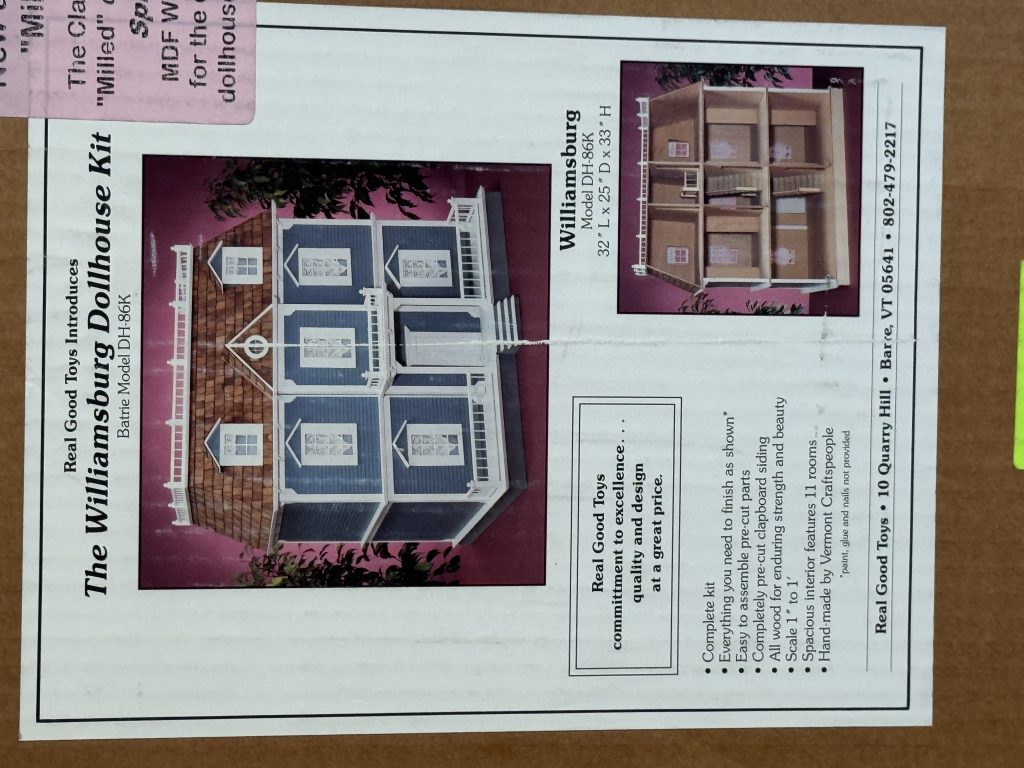
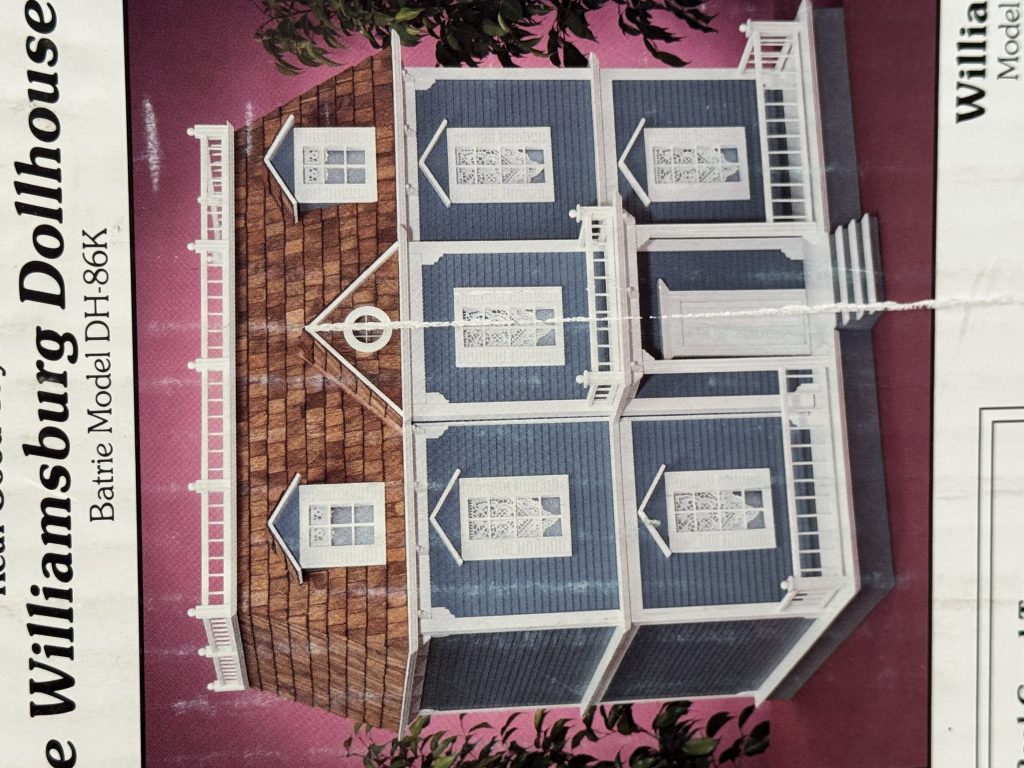
Real Good Toys WILLIAMSBURG dollhouse KIT. New in unopened box. Kit has been retired and therefore no longer available. VERY HARD TO FIND! 1:12 scale. Batrie Model DH 86K. When complete the 11 room dollhouse will measure 32″L x 25″D x 33″H. Dollhouse KIT will ship in original, factory sealed, unopened 50lb. box.
– Price includes $175. postage to contiguous United States. – Payment via PayPal only, please. – Final, as is, sale. – NO RETURNS, EXCHANGES, PARTIAL REFUNDS or REFUNDS WILL BE GIVEN FOR ANY REASON!
WHAT IS SAYS ON THE BOX: Complete kit as shown Everything you need to finish as shown* (*paint, glue, nails not provided) Easy to assemble pre-cut parts Completely pre-cut clapboard siding All wood for enduring strength and beauty Scale 1″ to 1′ Spacious interior features 11 rooms Hand made by Vermont Craftspeople
New and improved “milled walls”
The clapboard profile is “milled” directly into RGT’s splinter-free MDF wood fiber walls for the easiest-to-finish dollhouse kits ever made! MM-86K.
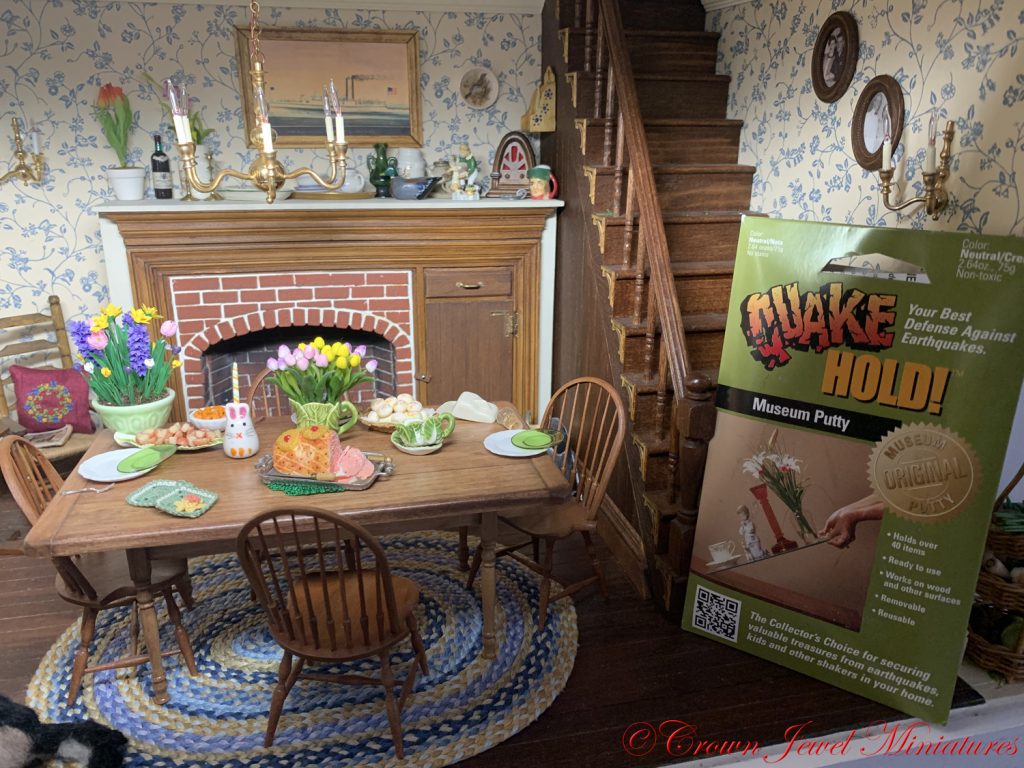
I never thought we would ever experience an earthquake here in Connecticut but today proved to be a real eye opener. A 4.8 magnitude earthquake (epicenter in New Jersey) shook our house along with everything in it, including Bob’s House!
Fortunately due to the Quake Hold I used to secure my minis, nothing fell. As you can see a few lightweight dishes on the dining table shifted but nothing was broken.
Season. It encompasses heavenly aromas of herbs and spices coming from the kitchen, snow or balmy weather and also experience or age but when it comes to dollhouses, the spices in our mortar and pestles are fake, inclement weather is never an issue and aging is only an issue when our mini newspapers become brittle. The season I’m referring to is the holiday season. Do you decorate your dollhouse in keeping with national holiday seasons and time of year? If not, you may be missing out on a change of pace that offers many opportunities!
Many of us are far too busy with our daily lives to find the time to decorate our dollhouses. In order to make room for a Christmas tree, you may need to temporarily remove a piece of furniture or two. Once you do that, the dollhouse may need to be cleaned before you can decorate and we all know cleaning the dollhouse with tiny paintbrushes and cotton swabs takes far more time than swinging a cordless vacuum into the corners of our real houses. So why bother? Is it worth the effort?
Yes!
That adorable Easter egg scene, Thanksgiving prep table and Hanukkah menorah can really lift your spirits! Many of us recreate holiday scenes from our childhood to honor the past or decorate for our favorite time of year, making our collections more personal and fun. In some cases the dollhouse or roombox is part of the decoration. A mini Santa’s workshop on the mantle in the living room always draws lots of happy comments from visitors and a mini bakery scene featuring bunnies and carrots creates quite a show in our dining rooms.
I got out of the habit of decorating Crown Jewel Manor for the holidays until it dawned on me that I could have holiday scenes in various rooms all year long! 365 days a year it is always Christmas in the Ballroom, Easter in the Breakfast Room and Thanksgiving in the Dining Room. I clean and refresh things every few months and add or change the decorations and foods once or twice a year but these rooms never cease to bring a smile to my face, year round!
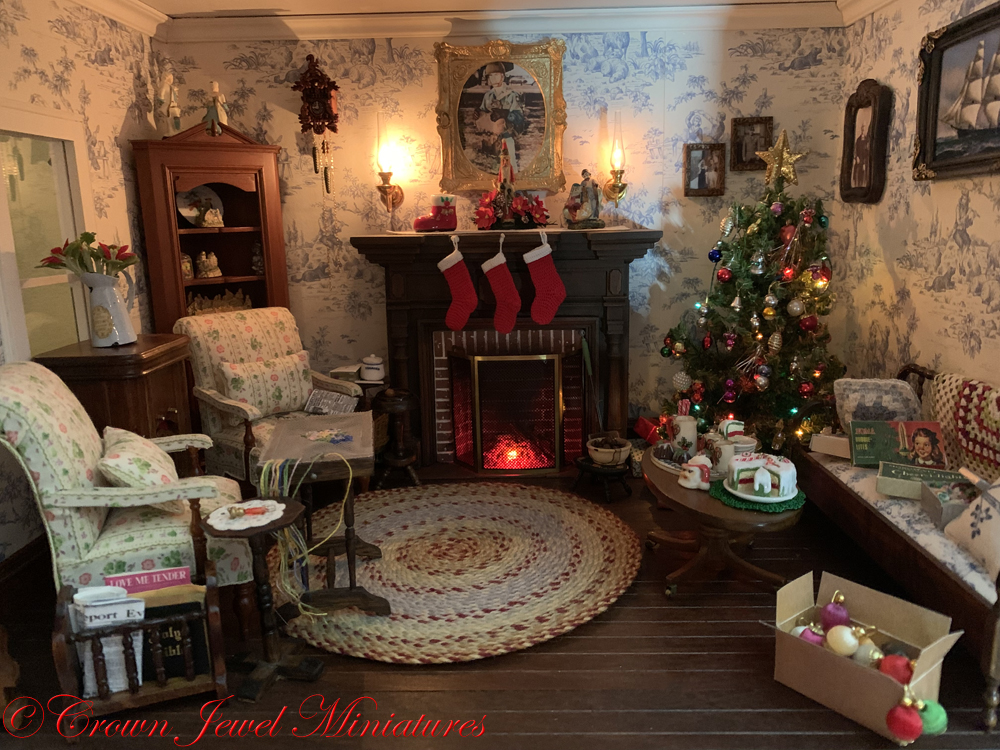
This is my first year decorating Bob’s House for the holidays and seasons and it’s been wonderful to change things up a bit. To make room for the Christmas tree, I had to remove a table and move the old radio but the happy surprise was that just a few small changes made the room feel even more special! Opportunity arose when I realized that maybe I won’t put the furniture back in quite the same layout, thus creating space for other unused minis.
I made the Christmas tree and ornaments from scratch.
Yes, it takes time and effort to change with the seasons but it’s a fine way to keep your collection from looking stale to your eyes. Break out those mini decorations! As always with miniatures, the sky is the limit when it comes to having everything you want. Cram as many pretty presents as you want under your mini tree! Make a slew of pricey French champagne bottles for your mini New Year’s Eve bash! Serve a stack of bunny cupcakes you would never eat on your diet! The land of Lilliput is enables us all to have our cake and eat it too… figuratively speaking.
Happy Holidays, mini friends!
Boxes of ornaments and a OOAK Christmas cake make a cheerful Christmas tree decorating scene in the living room of Bob’s House.
Next up… Wait ‘Til You See My Idea For Transforming A Placecard Holder Into A Miniature Bush!
You finally reach the stage where your tribute dollhouse is “ready”. The lighting, wallpaper and furniture is done and you’re at the stage where it’s time to accessorize. You add the basics, of course… groceries, linens, toiletries, etc… but what then? Even with a few OOAK artisan pieces, at this stage you likely have the same mass-produced wallpaper, furniture and object’s d’art as hundreds of other collectors. How do you personalize the collection and make it uniquely yours?
DNA!
You have one wholly unique thing that no other collector has, your genes. You know who you are and what makes you, “you”, so who are your mini inhabitants? You have already decided what era they lived in when you chose the style of house, but who will reside in your mini house? What are they like? Where are they from? What are their tastes? Even if you’re not adding dolls to your collection, each room of your dollhouse tells a story and you are their biographer, so to speak. Now is the time to decide who you want them to be.
When faced with a tribute dollhouse, like Bob’s House, the answer is simple. I decided the house would be my father’s boyhood home and he and his parents would be represented in it. There are several cultural accents in Bob’s House reflecting my father’s family tree. Once you choose who resides in your mini house, the rest is easy. Know your subject(s) and use the information of who they, and their ancestors, were to make your collection truly original.
Let’s start with food.
As a professional food artisan, I have received many requests for custom work over the years. Collectors often ask for familiar foods or foods from their childhood but most requests are for ethnic foods… favorite family dishes passed down over generations were some of the most requested foods coming out of the Crown Jewel Imaginarium!
Regardless of the origin of your roots, chances are there is a familiar dish your grandparents, aunts and uncles made and serving it in your dollhouse is a relatively easy way to “add DNA” to your collection. My Irish, British and German ancestry are the inspiration to a variety of foods in Bob’s House you would not think to combine elsewhere and that uniquity (or oddity, LOL) is what makes it mine.
Arts & Crafts
Honoring my German great great grandparents who came to America from Dresden, I researched antiques from the 1800’s in that area and discovered traditional Dresden porcelain china was (and still is) world renowned. I added tiny “porcelain” figurines in the living room and a traditional cuckoo clock (see photo above). An Irish friend has a tiny shillelagh in her mini collection and one of my collectors in Mexico has the most beautiful Mayan terra cotta figurines on a prominent mini shelf in her collection.
Linens
Regional differences in linens are enchanting! Tiny folkart designs on Scandanavian tea towels, Navajo rugs and throws, Sichuan bamboo mats, flax towels from France and Northern Ireland and Turkish carpets, to name a few, can help put your genetic stamp on your collection.
Furniture
So your grandmother is from Italy? Consider the era of your dollhouse and look into various styles of chairs from her region that she would have used. Russian wood burning stoves were quite decorative, usually tiled or handpainted porcelain and make quite a statement even in a modern dollhouse in the sunroom! A rough hewn stool from 19th century Scotland can be the perfect accent as a plant stand near a sunny window.
Fine Art
Your great grandfather was Dutch? Perhaps a beautiful Van Gogh painting above your mini mantle? The Starry Night is just as popular and lovely now as it was in June of 1889!
There are so many ways to “add DNA” to your dollhouse!
Cultural elements need not be obvious, but you will know they are there and that is all that matters. Marble countertops in your kitchen would be a fabulous nod to your Italian ancestry! So much of the home decor we love today actually has roots in previous decades and centuries. Ancient Romans were using granite long before it became a fad in our kitchens and the Egyptians certainly had a way with tile! The homey braided rugs gracing our floors were a way of life in Colonial America! Ukrainians were decorating beautifully intricate Easter eggs by hand long before Paas began selling those cute little kits! A quick search on Google can help you add authentic cultural elements to your collection relevant to your ancestors or the imaginary mini inhabitants you choose to represent.
Memories light the way.
If your DNA is the backstory to your tribute dollhouse, then memories and anecdotes are easily the illustrations to your draft. Your favorite uncle carved wood and you’ve added small wood carvings to your decor. Your grandmother loved to garden and you’ve added vases of her favorite flowers to the dining room table. Your grandpa loved to barbecue for the family and you’ve set up a big picnic scene on your mini patio. Your zany Aunt Tillie adored purple scarves and you’ve added one to your mini coat rack. These are the elements that speak to you, that make your collection relevant in a way no pretty, mass produced mini ever could.
Can’t find an element you need? Make it yourself! If you have to whittle that little duck carving for your mantle yourself and it doesn’t really look much like a duck your Uncle Horace made, so what? It’s original art and original art comes in all manner of expression. Make it yourself and make it your own!
Every item you choose to add to your dollhouse is the “right” item but choosing cultural items that speak to your soul can make it an heirloom. It’s an extension of you and your family and it can’t get any more unique than that! Choose the narrative for your dollhouse and let the accessories reveal your personal story. It will speak to you in so many lovely languages.
Next up… To “Season” or not season your dollhouse, that is the question!
Selecting artwork to display inside the dollhouse has never been much of an issue with me. I simply selected ready-made, framed pieces sold online and in dollhouse shops that matched the theme or decor of the room.
That was until a certain 19th century sea captain with hair-raising timing changed everything.
Ready to beautify my empty walls, I brought my stash of mini picture frames and framed art out of the Imaginarium closet and began to sort through what I had. There were several ornate picture frames, (obviously intended for Crown Jewel Manor) as well as plainer ones (better suited to Bob’s House). I set those aside for family photos, already determined to “personalize” this tribute house in ways I had not done in previous projects.
Next, I sifted through framed artwork. I had a few unusual landscapes, some depictions of an English hunt, several famous paintings and far, far too many sepia toned portraits of people I didn’t know… often advertised as “instant ancestors”.
I believe the good Captain took offense to the latter, for what transpired next actually gave me the chills!
I almost had everything I did not intend to use back in the box, when I realized two framed pictures were actually stuck together. Gently I pried the two frames apart and was surprised on two counts… I had not damaged the “painting” on the bottom and… it was a boat! It was an unusual boat, to be sure… I had no idea how it came to be in my collection or what type of boat it was… I only knew I found it intriguing and it seemed like a good fit in a late 1940’s seaside farmhouse with a 12 year old boy who loved the sea.
I propped it up on the mantle in the dining room of Bob’s House and turned my thoughts to making mini family photos. What was unusual, is that I did not attach the picture to the wall right away. Normally I would have grabbed a bit of MiniHold and hung it on the wall immediately, but this time, I hesitated, and I don’t know why. I was about to make mini photographs but was not in any sort of rush.
My father was a true family man with a big heart and he kept his family close his entire life. Even those who had passed on were never far from his thoughts and his dear mother, my Grandmother, sat like a star on a Christmas tree at the top of his list of The Unforgotten. Dad kept a portrait of her smiling face on his bedside table and another next to the recliner in his living room all his life so I knew that Bob’s House needed photos of family… and the “fake ancestors” I had collected over the years would not do.
The question was, how to reduce the old sepia and black and white family photos I had to the right scale. In the past when I wanted to insert photos into my jewelry lockets, I simply cut out pictures of family in the background of full size photos but now I had to shrink them properly. Dad was often bemused with half-baked work.
It’s actually quite simple and there is more than one way to do it but I simply placed my old family photos (3X5″ and 4X6″) on the bed of my scanner, toggled to “Advanced Options”, selected “25%” for Image Size, pressed “Copy” and voila! Tiny images of familiar faces ready to frame for the dollhouse! Of course, this feature was not known to me when I first tried this 20 years ago with my new locket but all’s well that ends well and now I have photos of my parents, grandparents, great grandparents, etc on the walls and tabletops of Bob’s House!
I made the photo of Dad (in his 82nd Airborne parachute rigging just before his qualifying jump), slightly larger than the others and hung it over the mantle in the living room… pride of place in his miniature tribute house.
Photo of my Dad in the 82nd Airborne takes pride of place in the living room.Family photos on the walls of the living room.Photos of my parents on the nightstand and wall.
Enter Ancestry.com…
After printing my downsized family photos, a leaf (a hint to new information) popped up on my screen and with a few simple clicks I had my family tree before me and clicked the leaf next to Charles F. Weeks (1815-1883), my great-great-great-great grandfather (on my father’s side) who has been in my family tree for over two decades with little information beyond the date of his birth. The leaf took me to my Newspapers.com subscription where I read several vintage newspaper articles about Captain Charles Weeks his life and career. Having established the captain was indeed the same person as my GGGG-grandfather via various documents and sources, I found myself back on Newspapers.com, and read with no small amount of fascination that Capt. Weeks was one of the oldest steamboat commanders when he passed away and during the course of his career he was known as a “daring navigator”. The articles made reference to his steamboat, The Bridgeport and curious, I searched Google to see if there was a sketch.
Captain Charles F. Weeks’ steamship The Bridgeport. Rendered in ink by Charles Parsons.
AHOY!
My jaw dropped the second I saw it! The Bridgeport was eerily similar to the ship in the old dollhouse picture! I had that mini picture in my stash for better than 20 years in the bottom of a box and here I was staring at the same sort of ship… a ship I had never seen before nor known anything about!!!
A chill went up my spine for coincidences and timing like this are not to be lightly dismissed. I honestly had goose bumps as my mind raced faster than one of Capt. Weeks’ steamships as I attempted to wrap my head around all of this. I couldn’t believe my eyes, but fate… luck… a competitive sea captain… something was bubbling to the surface here! I knew right away that The Bridgeport needed to be hung over the dining room fireplace in Bob’s House, not the vintage mini picture I had found… but that was until I saw The Nimrod!
My Google search had taken me via the Catalogs of the MarinersMuseum.org to The Bridgeport and below the link to The Bridgeport was Captain Weeks’ previous steamship, The Nimrod, in all its glory, rendered in watercolor by the famed maritime painter Jurgan Frederick Huge in 1843! The Bridgeport was newer and sleeker but something about The Nimrod appealed to me. Perhaps it was the incredible color that Mr. Huge imparted into the ship’s detailing in his painting, or Old Glory waving proudly off the stern, or the tiny sailboat in the background dwarfed by my GGGG grandfather’s ship as it sliced through the water but this one… this ship really spoke to me.
Just amazing!
Captain Charles F. Weeks’ steamboat The Nimrod. 1843 Watercolor by Jurgan Frederick Huge.
I sat back in my chair slackjawed, hardly able to believe my good fortune! Not only had I learned more about my GGGG grandfather than I had ever known, I knew then and there he was behind all of these fast-coming revelations. It was as if he is up there somewhere, saying “Don’t use that anonymous old dollhouse picture, use MY ship! Keep it in the family!”
Alright, Grandpa Weeks… I will do just that, Sir!… and I did.
I immediately ordered lithographs of both The Bridgeport and The Nimrod (via MarinersMuseum.org) for my family tree archives and set to work on rendering the online images of The Nimrod and The Bridgeport into miniatures.
Next I made a pair of nice mini frames from scratch (I used dollhouse chair rail molding) and now both ships are proudly displayed in Bob’s House… at the behest of the rightfully insulted Capt. Weeks. No wonder I hadn’t hung that picture of the intriguing ship in the dining room, it wasn’t the “right” one!
The Nimrod above the mantle in the dining room of Bob’s House.The Bridgeport on the wall of Little Bob’s room.
Now if you don’t think this (true) story can get any stranger, think twice! A few weeks ago I had printed mini mail with my Dad’s family’s name on it and stuffed the mini mailbox I had just painted black. The mailbox has hooks below to hold a newspaper and I went on Newpapers.com to find out what newspapers would be historically accurate for this place and time (1947 Bridgeport, Connecticut). I learned The Bridgeport Evening Farmer (1866-1917) was popular and printed several front pages to display in the various areas of Bob’s House including the mailbox.
Weeks later, can you guess which newspaper resulted in the Ancestry.com leaf hint that resulted in my discovering Capt. Charles Weeks and his steamships? If you guessed The Bridgeport Evening Farmer you are correct. What are the odds?
Here is a photo of a house flag I purchased for Bob’s House several weeks ago. I haven’t made a pole holder yet so the pole was temporarily stuck into the mailbox to hold it up, but there is the copy of The Bridgeport Evening Farmer! These coincidences are so bizarre it’s enough to make your head spin! I really should have saved this blog entry and posted it on Halloween, hahaha! (Note: a porch is being built for this side of the tribute house. The steps, pond, etc are not permanent).
I only wish my father had lived long enough to learn that his GGG grandfather was a sea captain, like his GG grandfather before him. His eyes would have shone like diamonds of sunshine reflected on the water, upon seeing those ships and reading accounts of Capt. Weeks’ daring career.
Newspapers.com is amazing! Have you ever read a local newspaper from the 1800’s or 1900’s? It’s like falling into Alice’s rabbit hole but in a fun way! You learn things, fantastical things, you would normally never dream of… the cost of a winter coat or a loaf of bread in 1898… who was in the hospital, on vacation or in town for the weekend in the 1950’s, and then there are the human interest stories that span decades and simply boggle the imagination. I recently read of The Annual Pre-Thanksgiving Turkey Chase, a contest in Philadelphia the week before Thanksgiving 1947. The local butcher had set 25 live turkeys loose all around the city on random days and folks lucky enough to catch them had a fine holiday feast for their family and friends! I guess Bob Cratchit had it easy after all!
Discovering the life and ships of Captain Charles F. Weeks was a timely find for Bob’s House! The “daring navigator” of the 1840’s who was once one of the first night pilots through Long Island Sound was not going to be outpaced! The lame, nameless vessel from the bottom of my mini stash was no match for his sleek and beautiful steamships, The Nimrod and The Bridgeport and nothing less but the walls of Bob’s House would do. Captain Weeks demanded his place in this mini time capsule.
Nice to finally know you, Grandpa Weeks. Permission to come aboard has been granted, Sir!
Next up, (how will I EVER top THIS?)… Adding DNA To Your Dollhouse!
Changing furniture sometimes requires modifications to the room and when I received Oliver Clarke’s amazing OOAK stove I knew something had to be done. The Roper stove I removed offered a lot of display space. What to do?
I considered a hanging pot rack but I have one in Crown Jewel Manor and it displays pots and pans nicely, but not much else. On the Roper stove I had a utensil holder, spices, a bean pot, etc and I liked the character of having kitchenware on display. To achieve that, I needed shelves, but what kind of shelves?
How could I realistically display my cooking utensils on a shelf? A cook doesn’t reach up to pluck a whisk from a utensil holder sitting on a shelf over a stove. That’s when the idea of “S” hooks came to me. I had used them in Crown Jewel Manor for copper ladles and spoons and imagined shelves with utensils hanging from “S” hooks and a box of matches, a few pots and maybe an old tin sitting atop the shelf.
With this loose plan in mind, I rummaged through my stash to see what I had to work with. First I had to decide on the wood and this was easy. With shiplap on the walls any planked wood would be a good match and I had leftover sheets of Midwest grooved flooring (the same flooring I used to create the wardrobe shelves in Bob’s room; see previous post). With the grooved side on top, I cut the flooring to the desired length and sanded the side edges and front edge to slightly round (bull nose) the edges.
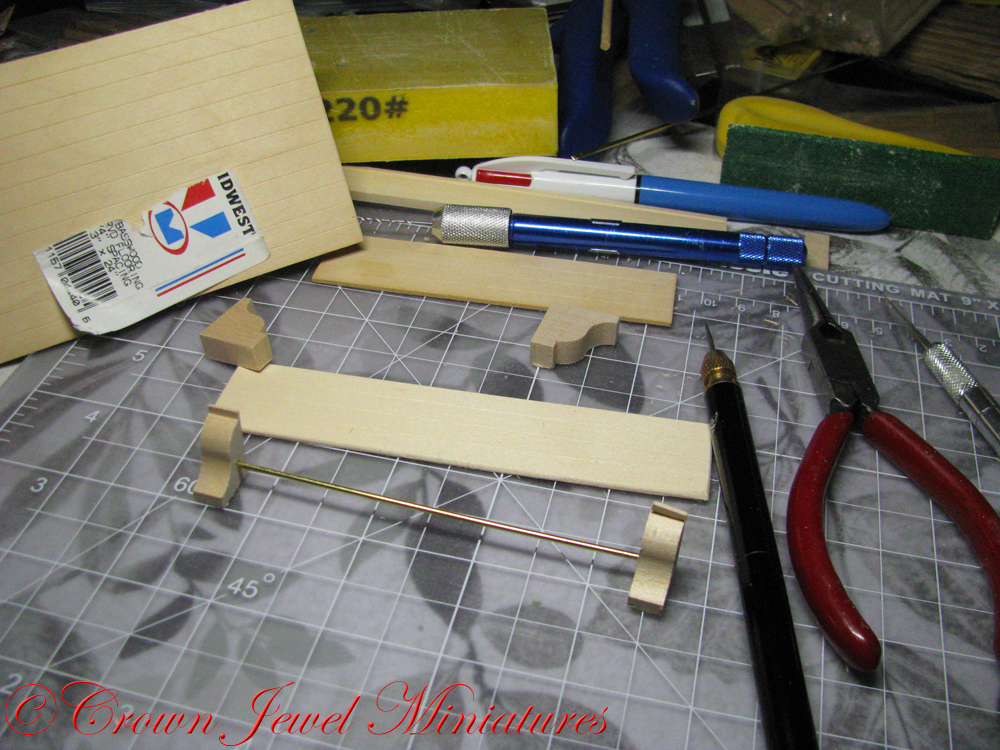
Next, I found a bag of wood brackets but they were a bit too long. Using my Easy Cutters I sliced off the thickness on one side of the bracket and did the same for the other, ensuring they were both the same size. Perfect!
Next, I had to decide what to use for the bar to hang the utensils on and how to attach it. I had wood dowels but they were too thick for the micro size “S” hooks I had so I kept searching the Imaginarium and came up with thin brass rods. I purchased the rods many years ago at a hobby shop, intending to use them as brass arms on mini chandeliers. To my surprise, they were not hollow as the shopkeeper said, and therefore unsuitable for chandelier making. Each measures 12″ in length and approximately 2mm in thickness. Thicker than wire and very strong. I used heavy duty wire cutters to snip the rods to the desired length.
Using my pin vise (hand drill) I drilled holes into the brackets and inserted the rods. This was a bit tricky as I had to ensure both holes were proportional in each bracket, otherwise the bar would be crooked. I opted not to glue the rods in, in case I ever wanted to slide them out in future to remove them.
At this stage I had a loose shelf and two brackets connected by a brass rod. Deciding whether to paint or stain was a challenge. In the end I opted to stain because I thought the paint would look too stark against the natural stone. I can always change this at a later date… you can paint over stain, you can’t stain wood through paint.
Next I glued the brackets to the bottom of the shelf. I left the rods in place to ensure the precise placement of the brackets on the shelf and aligned the back end of the brackets with the back edge of the shelf. The decision to attach the brackets before staining was intentional… glue does not adhere to varnish and the stain markers I use are small and flexible enough to get into tight spaces.
For stain, I used my trusty Varathane markers! I love this stain because it’s consistent, there are no fumes and it does not fade as the others I had tried. For this project I chose cherry to match the other furniture in the room. Working from left to right, I swiped the shelf from side to side in one stroke to keep the stain uniform. To ensure the best adhesion when gluing the shelves to your wall, do not stain the back of the bracket where it will contact the wall! Leave it bare. One of the great things about these markers is you can varnish the wood right away!
Use scrap wood to test different stains to find the perfect shade. Drag your stain marker from left to right in one long stroke to avoid splotchy stain.
I signed and dated each shelf in an inconspicuous area and used a soap and water cleanup satin varnish.
A smaller test piece, on the left.Notice that I did not stain the back of the brackets or the shelves. This allows your glue to grip the wood and hold it tight to the wall.
When the varnish was dry (15 minutes) I sanded the surface of the shelf lightly and added the final coat of varnish. I then repeated the process and made an identical shelf. In this next photo you can better see the grooves on the top of the shelves.
The biggest challenge to this project was attaching the shelves to the stone wall feature! Each shelf had to be permanently attached to the wall to ensure it would not fall off… and destroy the minis on the shelves. First, I dry fitted the shelves to determine their placement… the protrusion of the stones (and the recesses in between) were the deciding factor. I had to ensure the shelves were level and spaced evenly apart and that I had a solid area behind each bracket to glue the brackets on. This was not an easy feat!
Next I had to choose a glue. Liquid Nails seemed like the best option but the viscosity was too thick… it would have oozed out from behind the shelf edge creating globs above and below the shelf. Being a perfectionist, that was not an option.
Ultimately I mixed Quick Grip with a tiny bit of LocTite and it held beautifully! I used a paper plate to mix the two with a cocktail stick and applied the mixture to the back edge of the shelves and bracket with a needle tool. Not all edges of the shelves abutted with stone but the brackets did and that ensured the adhesion is rock solid.
The result, as you can see, offers tons of display and storage space! One of the great things about “S” hooks is you can add and remove them depending on what you want to hang and when and because I did not glue the rods into the brackets, I can slide them out at any time.
The shelves however are going nowhere. They’re rock solid and I don’t have to worry about them falling on Oliver Clarke’s amazing OOAK stove!
The kitchen in Bob’s House is beginning to look lived in and I am taking special care to outfit it with everything a mini cook would need to prepare meals. My father would be proud of the detail… he loved to cook and I plan to fill the kitchen with foods he loved to make but first I need to find my set of J. Getzan knives. My father had only the very best kitchen knives. He took excellent care of them and taught us how to care for them and treat them with respect to avoid injury. He always said a kitchen was not a kitchen without a set of good, sharp knives. Wise advice from a sharp man!
Next up, A Fascinating (True) Story Of How A 19th Century Sea Captain Makes His Way Into Bob’s House!
Who would have thought the mirror would be the hardest thing to find for the bathroom in Bob’s House? With the fixtures in, the custom cabinet complete (see my earlier post) and the hamper modified, it was time to for a mirror, but what kind?
I had a vintage “medicine cabinet” in my stash but didn’t like the way it protruded from the wall. A simple oval porcelain mirror would do but it was too thick and chunky. Making a mirror out of a picture frame could work! I decided that was the best route until I came across a Bespaq mirror on eBay.
It had a tray on bottom which I loved… good to hold a razor and bottle of after shave, etc and there were two tiny shelves on either side. Trays and shelves in miniature = display areas, which is always a bonus, so this mirror definitely had possibilities. After measuring between my sconces to ensure it would fit, I purchased one and hoped for the best.
My first thought with it in hand? Bespaq doesn’t really fit in a farmhouse, it’s too upscale.
The wood was beautiful, typical of the brand and it was nicely made but holding it in place I could see the stained wood was just too overpowering for the room so I grabbed the same Magnolia White paint I had just used to transform the cabinet and began to paint. I could not sand the mirror because doing so would have worn down the pretty raised detail so it required three coats of paint and a satin sealer.
As a rule I don’t paint Bespaq in order to preserve it’s value but I was so happy with the cottage feel the mirror had after it had been painted! The raised detail was now visible and being lighter the mirror blended nicely into the room instead of standing out like a sore thumb.
Because Bob’s House is a coastal farmhouse and Dad liked unusual shells, I rooted through my stash of mini shells until I found two shells big enough to notice on the mirror shelves and chose the two with the most color and character.
This mirror is not what I had in mind but it works beautifully and the modification was easy! If only I had noticed the red toothbrush had fallen on the floor before I took these pictures! LOL
Next up, Building Kitchen Shelves With Bars To Hang Utensils!
Have you ever searched and searched and searched for something for so long you lost hope of ever finding it?
I have coveted a vintage, 1940’s style double-door oven for MANY years. I looked in dollhouse shops, scoured the internet, watched YouTube to see if I could make one and asked folks on social media for help but nothing panned out. I even purchased a Hallmark Christmas ornament stove with working lights! I would have settled for just about anything… a basic, no frills model with non-opening doors, you name it, but it just wasn’t meant to be.
My checkbook was open but my hands were empty, as they say but life is full of surprises and someone special “across the pond”, whom I had never even met, was about to put the surprise of my mini dreams right into my hands…
Oliver Clarke.
I had no idea who he was when I discovered OC Miniatures on Etsy by chance. Based in the UK, Oliver makes the most incredible dollhouse miniatures… refrigerators, stoves. mixers, stoves, pots, pans…. and, oh did you see? Stoves! Everything he makes is eye candy for the miniature collector but his stoves really fascinated me. They were highly realistic and… functional too! His logo aptly sums up his art… “perfectly small”.
Sincerely impressed, I wrote to Oliver and sent him a photo of the style of stove I had in mind, a 1940’s O’Keefe Merritt “Wedgewood” model. I didn’t know if he had the time or inclination to take on the commission but I was beyond thrilled when he accepted! We traded a few emails discussing the design and before I knew it I had a package from Oliver, via the Royal Mail, on my doorstep.
Perfectly small simply does not do this one-of-a-kind stove justice!
Oliver’s talent is simply stunning! He included all the basics and the bells and whistles too! Both oven doors open, it has a central hot plate, and he had gone the extra mile and made a OOAK “Crown” logo for it too!
“Royal Mail”, yes indeed! This oven is the crown jewel of the kitchen in Bob’s House!
I feel blessed to have Oliver Clarke’s artistry among the works of other talented miniature artists for Bob’s House, a dollhouse tribute to my late father’s childhood. I am incredibly grateful for all he did to make my wish a reality, for he cannot know just how much it really means to me, how long I searched and how I despaired.
Thank you, Oliver Clarke. Endless thanks. You are hereby knighted Royal Stove Maker and I look forward to our next commission!
Oliver’s stove fit perfectly as I slid it into place beneath the newly installed kitchen shelves I had just made and I sighed with relief. It felt right. It was perfect, everything I had hoped for and more. I got a little emotional. This is it! This is the stove… the one that wasmeant to be.
With my flooring installed it was time to turn my attention to the fireplaces. I had two Braxton Payne fireplaces in my stash. Both were painted to resemble wood and had brick detail. I chose the larger of the two for the dining room and dry fitted it in place. Once I was certain of the placement, I marked the floor where the hearth would be and removed it from the room. I had always wanted glowing embers in the fireplaces for realism and it was much easier to do the wiring before installing the hearth.
I used a pin vise to drill a tiny hole through the floor inside the fireplace area and fed the wires of the ember bulb through the hole to the tape wire previously laid on the bottom of the house. I connected the wires to my tape run with tiny brass brads and tested the bulb to ensure it worked. I chose not to use the flickering embers as that would have required a separate circuit (otherwise all the lights in the dollhouse would flicker too).
With the wiring for the glowing embers complete, it was time to decide on the type of stone to use for my hearth. I tried just about everything in my stash… slate, sandstone, limestone, marble tile, etc until I eventually realized the fireplace itself, with its brick detailing, had already determined the correct selection for the hearth – brick.
Fortunately, I had a bag of thin bricks in my stash… much thinner than typical 1:12th scale bricks. Each brick measures only 3/4″L x 1/4″W x 1/16″H.
Returning the fireplace to the room I installed it to the wall and floor using Quick Grip. I dry fit the bricks into place and used my Easy Cutter to snip the corners and ends of the bricks near the inside perimeter of the fireplace. I used Quick Grip to secure the bricks to the floor, intentionally leaving very little room for grout. I only used a tiny dot of glue on the back of each brick to avoid excess glue filling up my grout lines.
Any miniature grout will do. I used leftover grout mix from a Magic Stone kit and added a generous tablespoon of Aleene’s Tacky Glue and a bit of water. Mix well and add a tiny drop or two more of water if the mixture is too thick. To protect my flooring, I put blue tape around the bricks I had installed.
Using a 1″ wide plastic spreader, I pressed the grout in between the bricks and into the tiny gap where the bricks meet the inner walls of the fireplace. This process took only a few minutes and I left the mortar to dry overnight. As mentioned in a previous post on installing the stone feature in the kitchen of Bob’s House, the addition of glue strengthens the mortar. It will not dissolve if cleaned with water nor crumble over time.
Before I removed the blue tape I used acrylic paint in brown iron oxide and carbon black and dry-brushed random areas of the new brick hearth to match the sooty character of the brick on the inner fireplace walls. This gives the hearth a convincing, used appearance.
I repeated this project with the livingroom fireplace as well and remembering my father’s diligent lessons on fire safety, I quickly added a firescreen. The effect is inviting and I can hardly wait to stage my Christmas scenes in Bob’s House!
I especially wanted glowing embers in Bob’s House. Aside from realism, it gives these rooms a warm, welcoming glow reflecting the loving memories that went into its creation. Every room tells a story and my father is at the heart of each tale.
Love will always light our way.
Next up, Mirror, Mirror On The Wall, a bathroom mirror install!
Needlework is a labor of love and every stitch tells a story. For my father, the story was a colorful crochet afghan with black borders, made by his mother, with love. He treasured it as he treasured her and when it was lost in a flood, he mourned its loss.
I had heard this story over the years but it wasn’t until 2020 that I got serious about learning to crochet.
“Try new things.”
Dad was always encouraging everyone to venture forth and be mindful of possibilities. I am not a needleworker, in fact I dislike sewing very much even though I made a few things for my family over the years. I have cross-stitched several Tidewater dollhouse rugs from kits but never got the hang of knitting. Embroidery is pretty far down my bucket list but I was determined to make an afghan for my father, so I would learn to crochet. I ordered a crochet hook and full size yarn and visited University of Google for a free tutorial.
Enter “Jayda In Stitches”. Her YouTube video on how to make a granny square was easy, informative and perfectly suited to a beginner in every respect. From her, I learned how to make a granny square afghan and when I presented it to Dad on Christmas 2021, it suddenly turned into a kaleidoscope… neither of us could see it through our tears.
“Now I have another afghan to treasure.“
The minute Bob’s House was done, I knew I had to make a mini afghan for Little Bob’s bed. I did not want to recreate the original colors, that was too personal, so I decided to make one to compliment the colors of the room. Soft and steel blue plus white. I was all set to try! I had already aced a real afghan, this couldn’t be much different. I just needed to figure out what size thread or hook to use, easy peasy, so I visited Hobby Lobby. Aunt Lydia’s #10 thread seemed small enough! I purchased a crochet hook in the size recommended on the label and came home to give it a whirl.
Only my “whirl” turned into a tailspin.
The thread was just too big and bulky. Of course with crochet, you cannot tell at first… you have to make several rows before your thread becomes fabric… you’re literally making fabric… what I had hoped would be a 3/4″ granny square was the size of a dollhouse bath mat! {Insert gameshow “Loser” BEEP here}.
At that point, I recalled the stash of silk thread I purchased years ago from a lady named Jeanne Bell. Jeanne used to come into Dollhouses Plus to drop off her latest needlework creations for us to sell on commission. Oh, she did exquisite work! I saved up for months to buy a tablecloth tatted of silk, as thin and fine as gossamer. It’s magical! Jeanne also did cross-stitch and embroidery on the tiniest silk netting and she braided a rug from silk threads, but I digress. If you’re fortunate enough to see any of her work for auction, grab it! You will not be disappointed.
On a random website, I learned folks were making mini crochet with a size 0 hook, so I ordered one, chose a lovely caramel color of Jeanne’s silk thread and got to work. I had to wear double magnification and still could barely see the few stitches I was capable of producing. Jeanne’s silk thread was as soft as pulled taffy and would not stay on the hook! I don’t know how in the world I managed to make one simple scarf but suffice it to say I will never again complain about making 1:12th scale peas or rice ever again! This was torture in comparison because I did not have the right tool or the right type of thread.
“Never give up!”
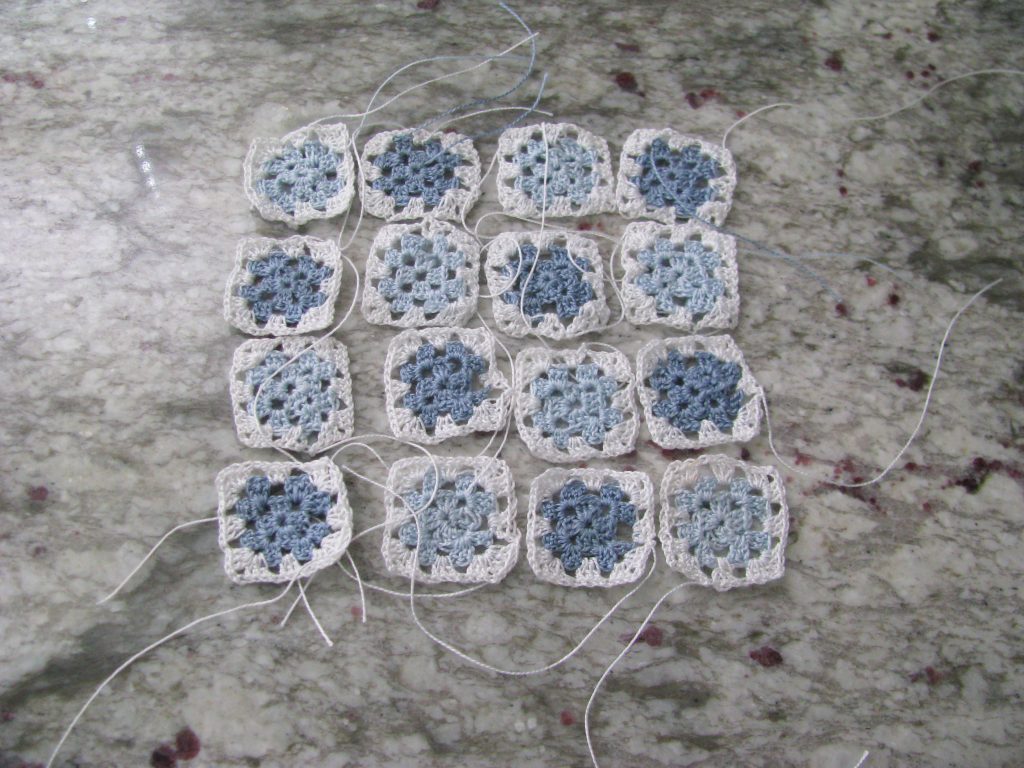
Back to University of Google! Via several websites, blogs and videos I cobbled together enough information to learn that a 1.0mm crochet hook and size 10 DMC Coton Perle thread should do the trick. Armed with these new sizes, I was able to produce my first 1:12 scale, granny square. I could not believe my eyes as each tiny square came together!
It took the same amount of time to make a mini afghan as it did to make a life size one but this was a labor of love, I didn’t mind at all. The result is exactly as I had hoped for. This size thread is sturdy enough to stay on the hook yet soft enough to drape nicely off the edge of the mini mattress.
I made a pillow too!
Teach yourself to crochet in full size first, find the right tools and materials and you too can crochet special things for your dollhouse!
Be Army strong, like Bob and persevere! I once asked him why he kept playing chess against himself. His reply was pure Brady! “Well, somebody has to lose and it sure as hell isn’t going to be me!”
That positive attitude is one of the many blessings my father passed on to me. Nothing can get in your way, except yourself and even then, only if you allow it.
Onward!
Next up, making a simple stone hearth for the fireplace!
As mentioned in my original post on Bob’s House, the shiplap walls for the bedroom, kitchen and bathroom proved to be quite a challenge! I needed beadboard for the bathroom and shiplap for Bob’s room and the kitchen. I ordered several different types of wood shiplap and beadboard sheeting for the walls. The prices ranged from very reasonable to very costly. Sadly, nothing I ordered gave the look of real shiplap or beadboard. The scoring on every model was so shallow that paint completely filled the tiny grooves and after it was painted it resembled plain, flat wallboard. It looked as if it had not been scored at all! I purchased and returned several different styles before I realized I would have to make the shiplap myself with individual strips of wood for it to look real. There are shiplap style wallpapers out there, but I wanted authenticity for my special project.
I purchased strip wood in two different widths. I used the wider boards in the kitchen and little Bob’s room and the narrow boards in the bathroom. I cut all the boards to approximately 2/3 of the height of the room and built the shiplap paneling one strip at a time. This method took much longer to install than sheeting would have, but the realistic results would have made Dad proud… he never cut corners!
Before installation I wallpapered the top third of the walls in the kitchen and bathroom. I meant to do the same for little Bob’s room but I was tired that evening and accidentally papered the entire wall. Oops!
Fully papered walls on the right
Decide how tall you want your shiplap to be and using a mini level and an L-square or ruler, draw lines on the wall below the wallpaper with a pencil. Use this as a guide to keep your shiplap level and even during installation. Do not use the floor as your guide as no dollhouse is ever perfectly square and once you attach a board using Quick Grip it cannot easily be removed (aside from a few moments when you first apply the glue).
Needing to space the boards evenly apart, I appropriated an old, thin 6″ metal ruler for the job and used it as a spacer. I put blue tape on one long side to use as a handle and that made the job much easier. Using my homemade spacer, I glued each board directly onto the walls using Quick Grip one at a time. I attached a board, let the glue set for about a minute, put the spacer into place along the long side of the board and glued the next board into place alongside the spacer. Some boards were trimmed to accommodate the electrical outlets previously pounded into the tape wire. It was tedious but at long last I had the results I wanted, perfectly spaced, real shiplap!
Homemade Spacer on right
Next I made the Shaker peg rails. If you do not want pegs, simply use strip wood in a width of your choice and apply it horizontally on top of the boards. Paint (or stain) it first, then adhere to the wall with Quick Grip.
Stay tuned to this blog for exciting information on the upcoming tutorial for Shaker peg rails! Hint: some of the best tutorials appear in dollhouse magazines!
I painted the Shaker peg rails and the baseboard molding before installation to avoid any risk of getting paint on my wallpaper and floors. I then covered the floors with protective wax paper (not shown), painted the shiplap and installed the baseboard molding and Shaker peg rails. In the case of the kitchen, I also used a satin (soap and water cleanup) sealer to give the paint that old fashioned shine. In the case of Bob’s room I stained the baseboard to match the floor.
Bathroom With Dry-Fitted Shaker Peg Rails (pegs on right wall not yet installed)Installing the bathroom baseboard last
If I had to do it again, I would have painted the shiplap boards individually before installation. Painting the walls afterward, I found myself dry brushing the grooves to keep the paint out and the definition between the boards intact. Lesson learned and isn’t that what DIY is all about?
Painting the shiplap and floor in the kitchen
Installing the shiplap individually seemed to take forever but I know Dad would be proud that I didn’t cut corners and it looks wonderful.
Bob’s House
Next up, making a special crochet afghan for Little Bob’s bedroom!
Today I worked on the bathroom in Bob’s House. It’s mostly all soft magnolia white, except for the hint of black in the penny tiles and the steel blue vines on the wallpaper so I’m painting a few things to match and want to share a wonderful discovery with you.
A while back I purchased a beautiful wicker clothes hamper on eBay. It is signed “Leilani Warling 1990”. Unpainted, it looked appropriate for a farmhouse but a farmhouse by the sea usually has a good amount of white painted wicker, so I decided I would paint it.
Taking care not to paint over Leilani’s signature on the bottom, I started painting with a half dry brush so as not to glob paint in between the whips of wicker. I was using a chalk paint recommended by a dear friend and wow did it ever deliver! The hamper went from this:
To this:
To finish, I added a few scraps of fabric from my stash to resemble clothes and it’s now in the bathroom all ready for laundry day!
Unlike that “fresh painted” appearance basic acrylic paint would have rendered, the chalk paint made Leilani’s hamper look even more real! It’s not shiny or thick paint, it’s just right and now I plan to paint all of my wicker minis with it! Chalk paint, go figure!
The results you get when you “try new things“. Thanks Dad!
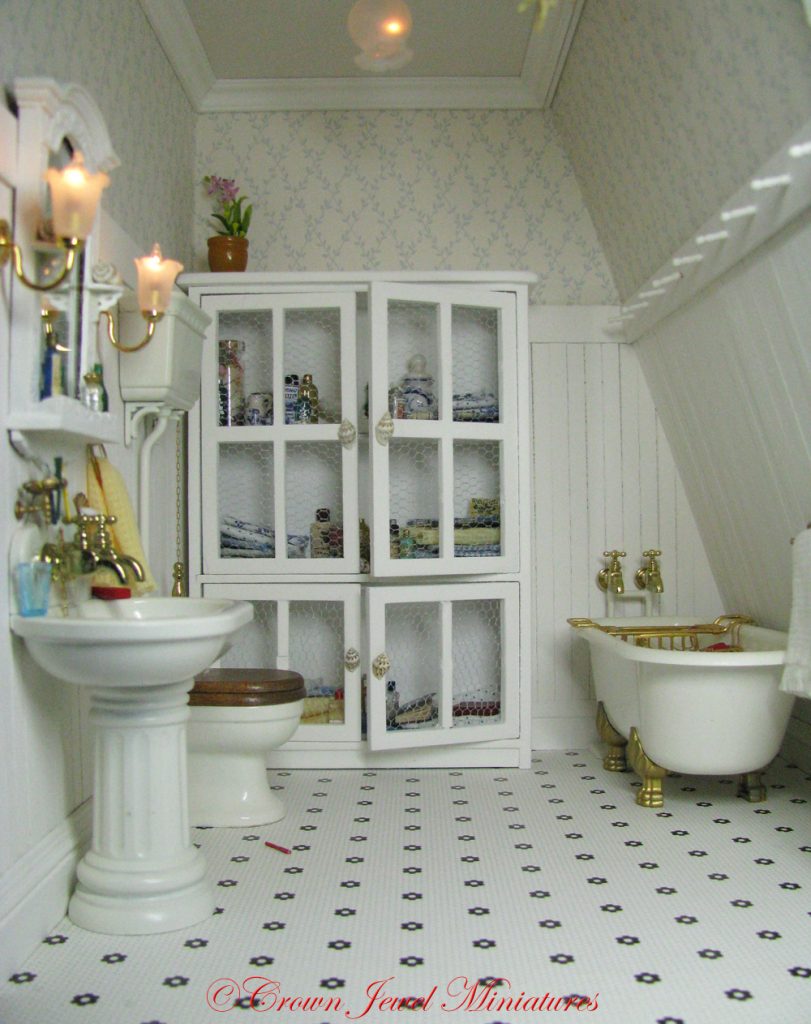
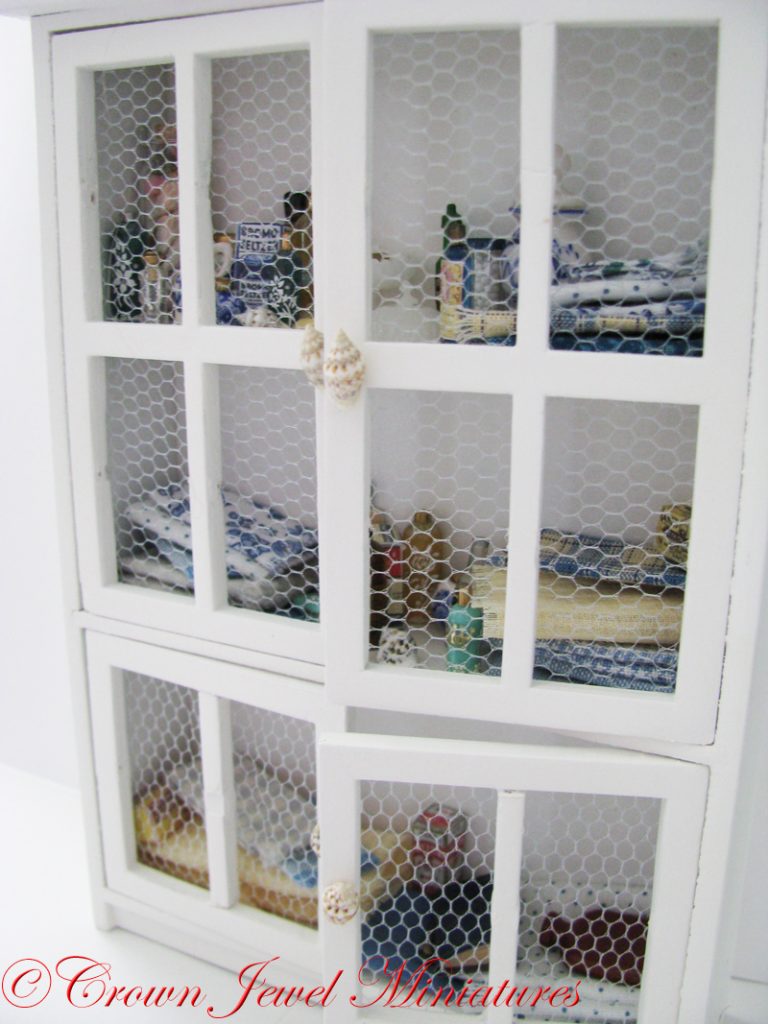
I also bashed a bathroom cabinet for towels and toiletries today! I removed half the panes and the fake glass from an inexpensive white cabinet and painted it to match the soft magnolia shiplap in the bathroom.
Bob’s House is a farmhouse near the coast and I made some unusual changes because I want it to be unique. First, I lined the doors with “chicken coop wire”. I had window screen but the grid is square, so to get an authentic chicken wire look, I use tulle. I had a few colors on hand and chose baby blue. I was all out of silver but you can make yours silver by spraying a piece with silver spraypaint. I decided not to paint mine. The tulle is so fine and delicate that the baby blue looked silvery and I could still see my toiletries and towels through it which was my goal. If I change my mind later, I’ll simply apply silver acrylic paint with a brush.
Next I went through my stash of hardware. Brass, wood, metal… nothing jumped out at me. As I was wondering what to use, a tall jar of shells I had made for inside the cabinet gave me the inspiration to rummage through my stash of mini shells and use shells as handles! I wasn’t sure if I had four relatively similar in style and the same size, but I came pretty close and now the cabinet is OOAK!
I kitted out the inside with colorful resin bottles and tubes I had made, a few pieces of china and other things of interest. I found a “Pharmacy” book, a metal hot water bottle and a scrap of soap I had made and added those too, taking care to arrange it in a realistic way that seemed “used”, not “perfect” like a shop display. I finished with a few loose shells and a “milkglass” Chrysnbon candy dish to which I added a powder puff.
Anyone up for a luxurious soak in the dollhouse tub?
I still need a few more things… razor, bath mat, towels to hang, toothbrushes, a plunger, tissues, toilet tissue, etc but for now Little Bob and his family can lather up and smell nice!
Next up, the challenge of getting realistic shiplap on the walls!
So your dollhouse or roombox is built and wired and you’ve finished the ceiling, walls and floors. You have a few pieces of furniture and some nice accessories in hand too. What’s next?
Closets!
Before you start furnishing the room consider the realism and character a closet, or pantry adds to the room. Instead of a plain, square box, your room can look like a real thing with the addition of this one simple feature! In this next photo you can see how plain the bed looks in a square box of a room. It looked far more real after the closet was installed!
Building my closet was so easy and quick that I did not think to take photos, so I’ll just describe what I did.
I chose to build my closet into a corner, therefore I only needed to make two closet walls and put a door into one of them. I used two 4″ wide planks of basswood purchased at Hobby Lobby for my closet walls but you can use foamboard or MDF or whatever you have on hand. Simply measure the height of your room and cut your walls to that length.
Next, decide how wide and deep you want your closet to be. I had a basic six panel door measuring 3-3/8″W so I needed my front panel to be wider than the width of my door. I cut my front panel to 1/2″ wider than my door and then cut my side panel to 3-1/8″W. My closet is quite generous but you can easily make yours smaller or larger simply by cutting your front and side panels to suit your needs.
With my front and side panels cut to the right height, I cut out the opening for the door into the front panel. I then wallpapered the insides of both closet walls, painted the door (inside and out) and added door knobs. Lastly I glued the door into the opening of my front panel. I now had a front panel, wallpapered inside with a painted door glued into place and a side panel, wallpapered inside. At this point you will want to resist the urge to glue the front and side panels together because you will not be able to install them as an assembled unit (Google “Pythagorean theorem” to learn why).
Next, simply glue the side panel into place and then glue a small dowel, left to right, to hang your mini clothes and add a stripwood board above the dowel for a shelf. It’s starting to look like a closet! Glue the front panel with door to the wall and to the cut edge of the side panel. Voila! The easiest closet ever.
If you want a light inside, simply install lighting before installing the two closet walls.
The inside of my closet was so spacious I decided to use it as a small hall instead! I installed a false door on the back wall, mounted a hurricane lamp on the wall for realism and added baseboard molding. The abandoned vacuum cleaner inside adds to the realism. Mother left it there in haste as she raced off to take the bread out of the oven!
I will add a closet to this room too (in the opposite corner on the back wall) but at this stage family were visiting and I wanted to share Bob’s House with them so I chose to table the project. Everyone asks where the second door leads to. The answer? You decide, it’s up to your imagination!
When making the pantry below stairs in Bob’s House, I used strip wood to line the walls and it looks like real lumber! To make a realistic closet interior simply line the inside walls with stripwood. It’s easy!
Little Bob’s closet was an entirely different installation thanks to an idea I had to transform a wardrobe into a closet!
The wardrobe provided space to hang clothes and had drawers but Dad had said there were built-in shelves above his closet. To achieve this, I decided to frame the wardrobe on three sides and build shelves above it to make it appear as one unit. I grabbed a few sheets of the same grooved wood flooring I had leftover from the floors and got to work framing the wardrobe. I used scored sheeting by Midwest Products found in most craft stores.
At first I couldn’t decide which corner to place it in so I put the furniture into the room and dry fit the pieces of my closet into both corners. That helped me decide where the closet should go. I then wallpapered the room (and installed crown molding – oh no!).
For the back, I cut the flooring to the same width of the wardrobe and the same height as the room (minus the crown molding, ugh!). Once again, in my grief, I had made a mistake. I installed the crown molding in the room before installing the closet! Undaunted, I carved the crown molding around the closet to butt up flush against the existing crown molding. It wasn’t easy but I persevered! I’m intentionally pointing out my faux pas on this project to encourage those of you in the same situation. Expect these types of errors and don’t let grief stop you from pushing forth!
For the sides I cut the flooring the same depth as the wardrobe and the same height as the room (minus the crown molding). With the flooring cut, I framed the wardrobe on three sides, (left, right and back) with the grooves in the sheet flooring facing into the room.
I glued the back panel directly onto the wall in the corner of the room. I then glued the left side panel to the left wall of the room. Next I glued the wardrobe flush against both sides and lastly I glued the right side panel flush against the side of the wardrobe. After the assembly was dry, I cut strip wood to size for the shelves and painted the assembly the same color as the shiplap would be. I chose not to paint the inside of the wardrobe and drawers and left them natural. Lastly, I installed the carved-out crown molding and then added thin quarter-round molding to both sides of the closet.
The unmarked wardrobe was beautifully handcrafted making this closet a OOAK. My father loved books and soon the shelves will be filled with the books he enjoyed, a few games and other items he was interested in. For now, a loon and moose occupy the shelves in homage to his affinity with Maine and the many outdoor sports he pursued there.
Next up, painting wicker and creating chicken wire for a farmhouse cabinet!
The kitchen of Bob’s House turned out to be the most labor intensive aspect of the entire project. In my last post, I shared with you how I almost forgot to add the pantry and had to rip out a wall and reroute my wiring to make it happen. In this post, I will share how I made and installed the stone feature behind the stove as well as the stenciled floor.
Construction of old farmhouses often include using natural materials off the land. Farmers used what was available and rarely shopped in stores for what they could cobble together themselves, hence my idea to use natural field stone instead of bricks or tile.
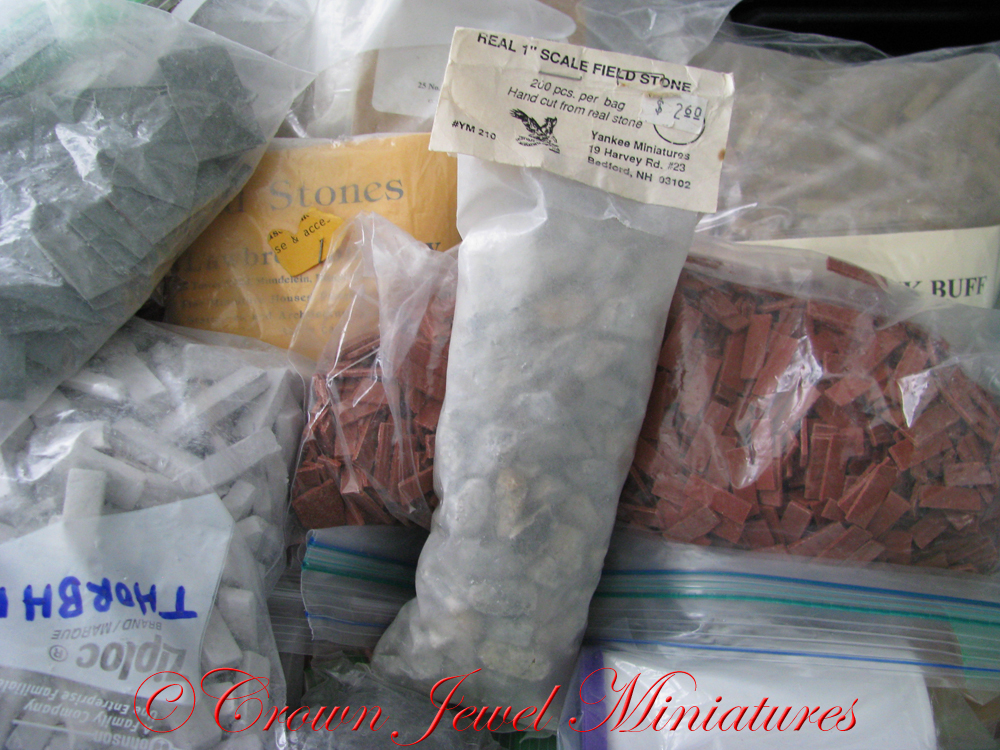
Many years ago I purchased a huge lot of stone, bricks and slate online and in it was an old bag of natural field stone, hand cut to 1:12th scale in New Hampshire. The company is long since gone, but the quality of these stones are amazing in their simplicity and perfect for the backdrop of my stove.
Vintage Yankee Miniatures Field Stone
It took 2 days to find them, hahaha!
I looked at the bag with no small amount of chagrin. How was I going to adhere these to the wall, keeping straight edges along the sides and get mortar in between to look realistic? My solution was to cut a piece of extremely thin birch sheeting to size for the base. I had some leftover from when I paneled the walls of my mini gent’s library in Crown Jewel Manor. Using this thin, flexible, sheet wood I could build the stone wall outside of the dollhouse and then install it.
Next, I recalled there were packets of dry mortar mix in the Magic Stone kits I had laying around. Years ago Millie (Dollhouses Plus) and I used Magic Stone kits to brick the exterior of a southern mansion dollhouse and she taught me a clever trick to make the mortar stronger… add glue!
With my thin sheet of birch cut to size, I mixed the mortar in a bowl; mortar powder, a huge squeeze of Aleene’s Tacky glue (about 2 tablespoons) and just enough water to get it to the right consistency (not too stiff but not runny). Using a plastic spreader, I smeared a thin layer of tacky glue all over the board and while still wet, I spread the mortar on the board to 1/8″ thickness. I worked one quarter of the board at a time so that the mortar would not dry out before all the stones were set. Working quickly, I selected each stone, one at a time, added glue to the bottom of each stone and pushed each stone into the mortar. The extra glue worked wonders and held every stone to the mortar with no issues. Taking care to keep the side edges of my birch sheet neat, I soon had a sheet of stone and set the assembly aside to dry overnight.
I then spread Quick Grip glue all over the back of the birch sheet and pressed it to the wall where I wanted it to go. I had to hold it in place, pressing against the corners and all over for a minute or two but eventually the glue dried and it’s rock solid now!
Originally I had planned to add narrow strips of wood trim down each side to frame it out but later I decided that definition would not be realistic in an old farmhouse. I had to add a smidge of extra mortar here and there around the edges to fill in a few gaps (especially near the ceiling) and voila! The stone backdrop added a lot of natural character to the kitchen!
With the stone feature finished, I turned my focus to the floor. Dad had said the wood kitchen floor had been painted and stamped. No pattern or color was recalled so I chose a natural color scheme appropriate for that era and home. Creamy beige walls with green stenciling. Nothing in this room could be stark white except the porcelain sink and appliances. The overall theme had to reflect the nature of a farm.
Note: I wallpapered and installed shiplap on the kitchen walls before painting the floor. Shiplap will be shown in the next post.
Suddenly I recalled a few tiny brass stencils I had purchased years ago. Most were not the style I wanted, they were too fancy and the micro checkerboard stencil (plastic) was more suited to the 1950’s but in the bottom of the case was a stencil with a leaf design. It resembled a fern but I thought it could work. Next I had to decide how this leaf would make a convincing floor pattern. A freehand design would work for walls, but a floor needed some sort of geometric pattern so I decided to make a grid with the leaves and angle the grid diagonally on the floor to keep it from resembling a checkerboard too much.
The floor was so beautiful in its original state that I cringed when I began to paint it. The wood was a gorgeous red oak left over from the same old DuraCraft dollhouse kit from which I had previously used scraps of strip wood for the pantry. I always save scraps and leftovers from kits and I’m so glad I did in this case because this quality of wood is no longer found in today’s dollhouse kits and is quite costly when purchased separately. The reason I selected this wood over cheap stripwood even though I was going to paint it, is the gorgeous wood grain. As expected, the grain shows right through the paint, adding an ultra dose of realism.
I gave the floor two coats of paint and left it to dry overnight. Using a pencil and ruler, I drew an “X” in the center of the room to use as guidelines for the stenciling. The brass stencil was so tiny that I needed a to make a “handle” that would allow me to lay it flat on the floor and hold in such a way to prevent any paint around the stencil from marking the floor. I used blue tape to create a flange by folding blue tape all around the edges of the stencil, like a picture frame and it worked beautifully.
Using a sponge tipped craft dowel, I dabbed most of the paint onto a paper plate and then dabbed the paint onto the stencil to stamp the paint onto the floor. A few times the images were blurry and I simply wiped them away using a damp paper towel and did them again. At first I attempted to measure an exact distance between each stamping but this quickly proved to be far more trouble than what it was worth so I simply “eyeballed” the spacing and accepted that stenciling in an old farmhouse would not be “perfect”. With this kind of realism in mind, I stopped being so fussy about some stampings looking a little blurry and kept stenciling away until the overall pattern began to take shape. I then used clear satin varnish (soap & water cleanup) to seal the floor against the inevitable scrape of furniture.
“Try new things”. Dad often strayed outside the bounds to create new things, like the time he siphoned gasoline from the gas tank of the General’s jeep to use as heating fuel for his troops on a bitter cold January night while out on Army manoeuvers. The men were toasty warm that night but the General was hot under the collar when he learned of this escapade the next morning and Dad was on KP and Latrine duty for weeks afterward. True story.
I told you he led a storied life!
By the time this project was finished I considered lightly sanding the floor to add a bit of “worn” character to the floorboards, but for now I’ve left it as is. I worry that the sanding might obliterate most of the stenciling as it was only dabbed on lightly. The brass stencil did not hold up very well and is now quite bent (from being pressed into corners and against walls) but still usable for smaller projects in future. This floor is truly one-of-a-kind. How befitting.
Wiring can be daunting but once you begin, it all falls into place and before you know it you’ve got lights and it’s brilliant, you feel like a genius!
Ok, but how to get there? If you’re an aspiring mini electrician, there are lots of tutorials online, including how-to’s on GreenleafDollhouses.com and Cir-KitConcepts.com as well as YouTube to walk you through it. It seems harder than it really is!
For this project, I chose tape wire (my preferred method instead of round) and gathered all my wiring tools (brads, tester, needlenose pliers, awl, mallet, etc). Next… and I know this may seem like putting the cart before the horse, but it’s necessary… fit your furniture into your dollhouse. This is essential to determining where you want to add fireplace embers, outlets for lamps, hallway lights, porch lights, oven and refrigerator lights, etc.
Use a pencil to mark your walls and floors where you want these things, remove your furniture and begin laying your tape wire. Fit your furniture once more to be certain everything is where you want it to be and the tape wire is at the right height. You can always add another tape run if necessary.
I tend to over-wire because I change things around in my dollhouses so much that I would rather have too many possibilities than too few.
After I have laid my tape wire, and tapped in all those tiny brass brads to make my connections, I put a piece of Invisible Magic Scotch Tape (not the shiny stuff!) on every end run and over every pair of brads. This protects my tape and brads from the moisture of paint.
Next, and this is vitally important, take pictures! Photograph every room from all angles and save those photos for future reference. This will save you the hassle of removing wallpaper or paneling to see where your connections or tape wire is should you need to troubleshoot or add more lights in the future.
I then paint over my tape wire as this prevents the tape wire from showing through the wallpaper. It’s important to use Invisible Magic Scotch tape because the shiny Scotch tape will not accept paint or wallpaper paste.
In my next photo you can see the tiny mirror I use to help me see in tight spaces and the difference between painted and unpainted tape wire. Notice the difference between painted tape wire in the bedroom on the right and bare tape wire in the rest of the house?
Now you can begin the task of wallpapering which I will not go into because I have already laid it all out in an earlier blog post. I always begin with the ceiling first (I use ceiling wallpaper), then the walls. Usually, my flooring is installed last except when I am installing shiplap or paneling on the walls because I want the paneling to sit atop the edges of my flooring.
Sometimes, it’s easier to wire, wallpaper or work on certain areas of your dollhouse with the dollhouse on its side. In this next photo I had put the dollhouse on its side to rip out the dividing wall I had just installed between the dining room and kitchen. I was just about to glue the staircase in on the dining room side of this wall when I remembered Dad had said the kitchen pantry was below the stairs! How had I forgotten this? Grief will do that to you.
I performed surgery on my pristine wiring (argh!), removed the wall with a hammer (and a boatload of frustration), cut the wall on the diagonal (same angle as the staircase), glued the staircase onto the back of the wall and proceeded to build a pantry out of scrap wood left over from an old DuraCraft dollhouse kit!
Building a pantry, below stairs, with scrap wood was a challenge as I had never built anything like it before, but as in many aspects of my life when I was uncertain, I could hear Dad cheering me on, telling me you’ll never know what you can achieve until you try. Even if this turned out to be a disaster, I would at least know where I stood.
Because the area behind the stairs was so narrow, it was best for me to build the pantry onto the back of the stairs, then panel the dining room side of the stairs and slide the entire assembly into place as one unit. Amazingly I had bested the gremlins of the Pythagorean theorem and it fit! I glued it into place and then hung a “bare bulb” light fixture from Lighting Bug to chase away the shadows.
Fortunately building my pantry was not a disaster and I walked away from the worktable that night feeling Dad’s presence. “You can do it!” “Try something new!” Near or far, he is always with me.
Next up, painting and stenciling the kitchen floor!
Losing a parent is never easy. Last year I lost my precious father, an amazing man whom I was extremely close to. In the last years of his storied life, he shared more and more about his childhood, growing up on a poultry and dairy farm. When he wasn’t delivering milk, eggs and chickens, he was a voracious reader who learned to fish, hunt, cook, fix automobiles, tend a large garden and play an acoustic guitar. Later he learned coastal navigation, astronomy and went on to become a U.S. Army paratrooper in the 505th of the 82nd Airborne.
Robert J. Brady, Sr.
“Jack of all trades, master of none” did NOT apply to my father. He was a man of many longstanding interests, so when my husband suggested I create a tribute dollhouse to my father, my eyes turned to an unusual “wall house” kit we had built in 2021.
The shell was complete and the tape wire had been installed but on that day, in January 2023, it was just a blank canvas. There were no windows or even a door. I had planned to make it into a farmhouse but perhaps it was never finished because it was destined for something better, something special?
I wondered.
Could I really do this? Can miniatures play a role in healing? Would this empty wall house transform to a fitting tribute to my father? I did not have the answers then, but I set to work inspired by Dad’s eagerness to try new things.
Four months later, it is now Bob’s House… a quirky little farmhouse on the rural outskirts of the coastal town of Bridgeport, CT set in the late 1940’s when my father was about 12 years old. This tribute to his childhood (and lifelong interests) became a powerful way to work through my grief. What was to be a nondescript farmhouse is now quite special to me, quirks and all.
Real Good Toys has long since retired their “wall houses”. These dollhouses have no windows or doors and the flat backs are intended to be bolted to the wall, like a kitchen cabinet.
This kit is the “Miniature Showcase” model which I found on eBay in late 2020. My husband added three windows and a door and I did not use all the room dividers, thus Bob’s House is 7 rooms instead of 9. I chose fewer, larger rooms in order to have enough space to build a closet, pantry and hall and to add a staircase. At some point I will also add a small porch to the left side of the house.
Bob’s House has been electrified and the wallpapering, flooring and shiplap are now complete. Most of the furniture is in place but it still needs the basics… curtains, towel bars, bedding, plants, wall art and, of course, my food!
Dad recalled the kitchen floor was painted and stenciled – check. There was always a bar of brown soap by the kitchen sink and red Lifebuoy in the bathroom – check. The staircase was in the dining room – check. The closet in his room had built in shelves above it – check and there were Shaker peg rails “everywhere” – check. These aspects were fairly straightforward to achieve but the shiplap walls for the bedroom, kitchen and bathroom proved to be quite a challenge (more on that in future posts).
The rooms are being filled with things my father talked about and loved. His mother, my grandmother, was an avid needleworker making all the clothing and soft furnishings for their home with her talent for crochet, sewing and cross-stitch, hence the sewing room. My grandmother always kept an African Violet in the kitchen window, Dad loved comic books as a boy and he recalled the heavenly aroma of fresh baked bread… all on my to-do list.
As I mentioned, Dad’s house had a few quirks! Via his memories, I’ve installed a pantry beneath the stairs in the kitchen with slanted shelving up top for storing wine bottles out of the kids’ reach… a built-in closet/bookcase in his room that had a squeaky door (not sure if I can make it squeaky, LOL), a bathtub without a shower head and Windsor chairs in the dining room.
Bob’s House is a work in progress and I will enjoy adding to it and making things for it over time. I’ve taught myself how to crochet in miniature and have already begun the granny square afghan for his mini boyhood bed. The full size afghan was special to him because his mother made it and he treasured it well into adulthood. I will post updated photos as my work progresses but for now I thought you might like to see the humble beginnings of a labor of love.
I took a few photos of random stages of development of Bob’s House along the way. Follow my blog posts as I share various projects for each room.
Hopefully my modest tribute dollhouse will inspire others to create tribute dollhouses or roomboxes for their loved ones too. It can help channel your sadness into something productive… a preservation of memories to honor those we’ve lost. In the fullness of time these tiny time-capsule tributes may help create a connection between the older and younger generations of our families. For now, mine is a tribute to a man who loved family and home as much as he did learning new things.
So, can miniatures play a role in healing?
For me the answer is yes. Art, in many different forms, has the power to express the human experience and miniatures, perhaps more than any other art form, reveal an intimate look inside the homes and daily lives of folks who lived in those homes. You can look at a snapshot of your grandmother’s kitchen but seeing and interacting with a replica of that same kitchen in miniature, is surely more provocative.
As I fill “Little Bob’s” bedroom with everything from a fishing creel to an acoustic guitar, I remember Dad teaching me to fish and strumming away into the wee hours on the night of my wedding reception. That brings a smile to my face…
That is healing.
Remember the good times, mini friends. They are worth preserving.
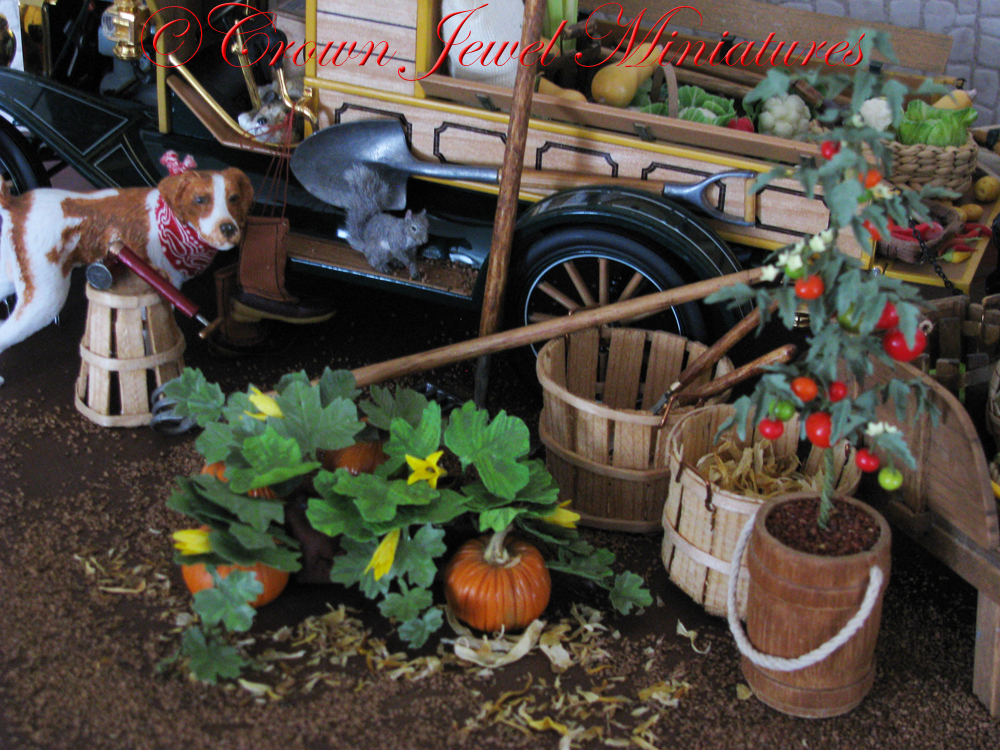
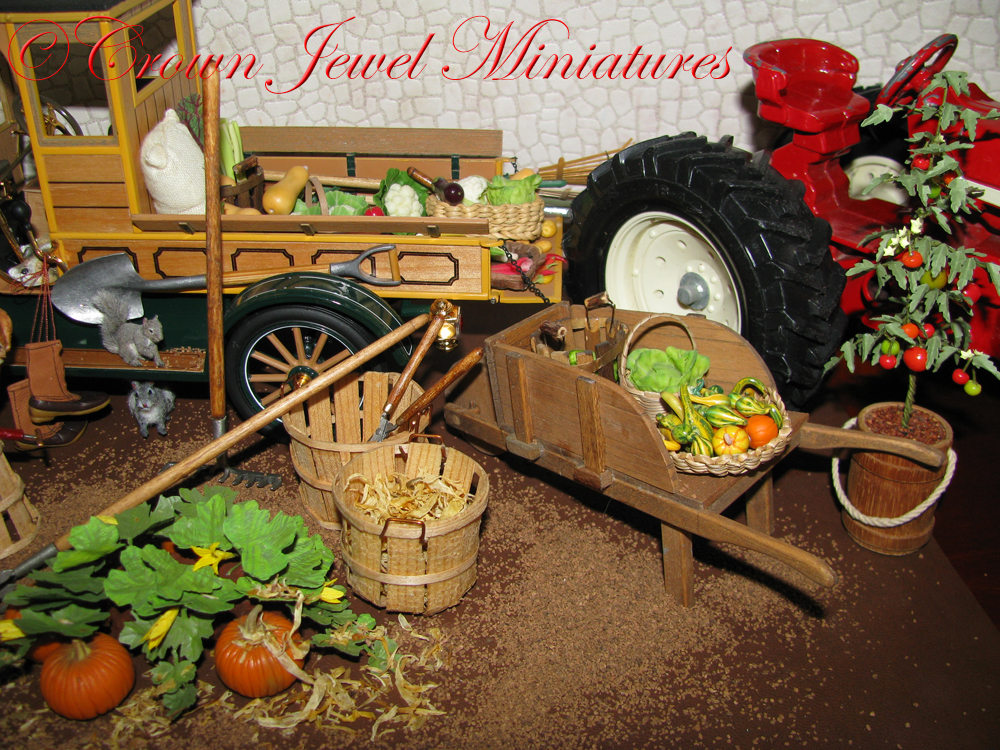
WANTED: Cleaning enthusiast to dust, sweep, mop and organize potting shed. Must be of diminutive stature, good with flowers and plants and above all must respect squirrels and frogs. Only well qualified applicants need apply.
Payment will be a basket of tomatoes off the vine and a full service dinner for six at Crown Jewel Manor. All food is zero calorie and looks far better than it tastes. LOL
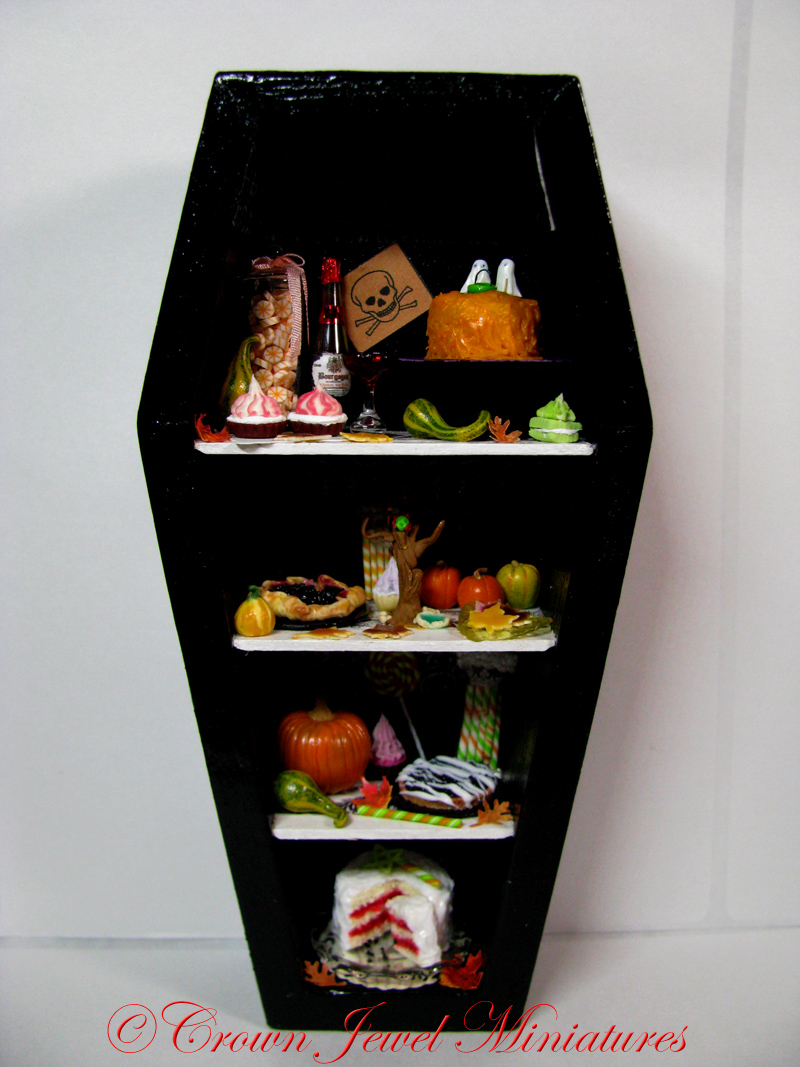
Countless hours are represented here, from dreaming up the food, to execution, sealing and finally cure time. Each tiny food seems to take on a life of its own, no two are ever alike. It looks like a jumble but each piece is then packed with tremendous care before shipping out to its new home and my tiles are, once again, bare… waiting for the next batch.
I love it when my collectors share photos of their minis with me. That’s often the best part of the day! Each collector is quite special to me, so kind and delightful to work with.
Here’s to the next batch of happiness. from my mini house to yours!
A few years ago my aging father lamented the loss of a granny square afghan his late mother had made. Over the years he lost track of it and was sad not to have it.
I knew absolutely nothing about granny square afghans. Dad said it was black with colorful squares, so when I returned home that night, I Googled it and was surprised to discover how beautiful they are and they were back in style!
I had no idea how to crochet but when you love someone, you want to please them so I found a few afghans on Google and showed them to Dad. He pointed to the one that most resembled his mother’s, and I found a how-to video by JaydaInStitches on YouTube that was very easy to follow. As luck would have it, putting all those colorful squares together was the hard part but I was determined and on Christmas day I presented Dad with the afghan. He teared up, I cried. It was a beautiful father-daughter moment.
You know how it goes with us artists. We’re always pushing ahead when it comes to creating so I decided to make a 1:12th scale scarf. Simple enough, right? {insert embarrassing laughter here}. I ordered a crochet hook on Amazon that is so tiny I could barely see it with the naked eye and I found pretty silk thread in my stash purchased from a professional 1:12th scale needlework artist many years ago. Jeanne Bell, rest her soul, tatted the tiniest, most exquisite 1:12th scale lace tablecloths I have ever seen! She also made 1:12 braided rugs with wool thread but I digress.
Long story short the silk thread was too floppy, the hook too small and the only reason I was able to complete the scarf was sheer, stubborn determination. I vowed never to make another piece of 1:12th crochet.
Never say never, right?
Yes, you guessed it! I’m in the process of a very, very special new project (blogs on that coming soon!) and need to make a 1:12th scale afghan for it. I would not have thought it possible but thanks to the advice of the amazing owner of Rosemary’s Yarn Shop in Maine, I learned a LOT about yarn and threads! I now have the appropriate thread (cotton perle) and the correct size hook. The hook is the size of a gnat but the tiny afghan is coming along great! Each square is approximately 3/4 of an inch.
Here is a photo of my work in progress. I will update this post when the afghan in complete.
1:12 granny square afghan WIP by Crown Jewel Miniatures
Meanwhile, keep pushing ahead and never say never! Keep trying until you reach your goal. The word “quit” isn’t in my vocabulary and shouldn’t be in yours either. You will surprise yourself and have something to show for it.
The dogs in Crown Jewel Manor are at it again!
Due to impending Hurricane Henri, there may be a delay in shipping orders. Thank you in advance for your kind patience. Stay safe, mini friends!
Coffee, cup o’ joe, java, espresso, cappuccino… call it what you will but it’s a nice hot cup of yummy and I’m serving it to you in tiny mugs personalized with hundreds of names and nicknames!
I bought the empty mugs several years ago as partial inventory of a dollhouse shop that closed in the late 1990’s. The mugs are very well made and no longer in production from this company (Mini Mug House). I filled each one with resin to resemble coffee with cream. The coffee color is not as dark as my pictures- the glare of the glazing on the white porcelain was a little too much for my camera lens. It’s a nice coffee & cream color but also resembles tea and cream if your mini dollhouse inhabitants prefer to drink their resin tea from a mug. 😉
Is your name there, or the name of a friend? Send me a message or email and if I have your name(s) in stock, I’ll send you a PayPal invoice. Each mug is only $5.00 + shipping. Buy three mugs and save! Three mugs for $12.00!
In addition, I have a select number of names in slightly different mugs with blue font:
Great for a breakfast display at the kitchen table, on a dollhouse coffee table near a magazine or set up a coffee klatch scene in your tiny parlor- the possibilities are endless!
The International Guild Of Miniature Artisans has a Code of Conduct I believe everyone should review and ascribe to. Member or not, it is often how we conduct ourselves that leaves a lasting impression. Making your impressions positive ones is especially important in today’s world. Here it is in it’s entirety. I couldn’t have said it better…
Code of Conduct Befitting an Artist
All artists should hold themselves to the highest standards of ethical conduct, respecting each other’s creativity, skills and unique place in the world of miniatures. The following guidelines and standards for artists were written by a group of IGMA Artisans and Fellows based on real situations which have arisen in the course of sharing their beautiful work with the world. These guidelines answer many questions about how they feel about their work being copied and outline their wishes as to how they would like their work to be respected, given those various situations.
Inspiring others is often a part of the artist’s mission and each new artist should use such inspiration to develop his or her own signature form of miniature art.
Artists who teach their techniques expect their students will go on to use those techniques in the process of creating work that is distinctly the students’ own.
No artist should take a class and then teach that same class, which offers the same techniques as the original, using another teacher’s written/visual materials or patterns without express written permission from the original teacher.
No artist should copy the work of another artist and offer it for sale. To do so is disrespectful of fellow artists and may negatively impact the collector and student base the original artist has worked hard to build up over the years.
Mere copying does not truly benefit the person who is doing it. Copying what you love is a good way to learn; but the goal of learning is to stretch yourself, and use what you have learned to take the next step. Ultimately, artists should develop work that expresses their own creative vision, and offers something new to collectors.
A wise artist will keep a record of the pieces they have made.
Artistic work is protected by international copyright law from the time of its creation.
All creators of tangible work have a legal right to protect that work, and to ask that others refrain from making copies for sale. This includes miniaturizing the work of any other artist or company; including, but not limited to, miniaturized art, product design, packaging, advertising, logos, etc. If one didn’t create the design, then one must ask permission to use it if it is not in the Public Domain.
Appearance of a work on the internet does not mean it is in the Public Domain. When a work has entered the Public Domain, it means that all copyrights on that work have expired. Copyrights are usually in force until at least 50 years after the death of the holder.
I’m stunned! I used Google to search for a “dollhouse castle clock” and stumbled upon my dream dollhouse. It’s a castle, of course. “Astolat Castle” is named for the castle in The Lady of Shallot, a 19th-century ballad by Alfred Lord Tennyson. The crenellated walls are so romantic and has the loveliest torch lights on the exterior and classic topiary on the balcony.
Oh, and it’s bargain priced… only 8.5 million dollars.
No, you’re not seeing things, that really is the price and it sure looks like it’s worth every penny. Scrolling down the photos, you see one meticulously curated room after another. A suit of armor stands sentry by the door. Crystal chandeliers and gilded French furniture lend an air of romance. Aahhh! It’s my dream dollhouse… I can’t make this up!
The library has a… wait. Go back to that last photo… the one with the gilded table… yes that one, the Salon! Is that a cheese board I made? ::: shaking my head ::: Don’t be silly! Ok, let’s move on with this magical mystery tour in the lovely dollhouse castle…
Photo by Zak DeZon/Bloomberg
There’s an amazing library, turreted rooms, a humidor with a fabulous collection of pipes for the mini gent and a bar. Every good dollhouse needs some hooch. Then…
OH MY GOSH! Now my eyes are bugging out of my head, because that turkey, sliced cranberry sauce, etc were definitely made by me… I just can’t believe my eyes… and look, I made the pumpkins in the next photo too! My art is in this incredible dollhouse??? What an honor! This kind of thing does not happen every day! I LOVE seeing my art in the dollhouses of my collectors, they have the most amazing collections but I can honestly say this is the priciest one I’m aware of… to date, lol.
Photo by Zak DeZon/Bloomberg
Photo by Zak DeZon/Bloomberg
Astolat Dollhouse is truly a work of art… and love. Be it humble or expensive, only a true collector expends this much love in bringing a miniature collection to life. It takes a lot of time and effort and the result is beautiful. Shrink me so I can move in?
I believe I know who the collector is, she’s always been fabulous to work with and I hope she sold the dollhouse to someone who will love it for many years to come.
This article was written back in 2015 but it’s still quite relevant today! Here we are in the midst of the horrible Covid-19 pandemic and there it is, folks…
… a miniature roll of “usable” toilet paper.
Photo by Zak DeZon/Bloomberg
As I said, I can’t make this up! You never know where your art will end up. All I know for certain is I love my collectors. They’re amazing people and I’m appreciative to help bring their mini food scenes to life in any small way.
Tupperware is quite handy for those times when you feel like throwing out your food another day.” LOL
Tupperware! It’s iconic and as I continue to work on my vintage kitchen roombox (a replica of my Grandmother’s kitchen), I decided to try my hand at making miniature Tupperware in 1:12th scale. These are my first attempts! I made them in turquoise, my favorite color, but my next attempts will be the familiar yellow my grandmother had her roomy kitchen cabinets. As a child, I loved seeing all the mixing bowls, Tupperware and Pyrex pans she had carefully organized on papered shelves.
Meanwhile these tiny prototypes are resting on a chair in my shabby kitchen. A hint of better things to come!
The bells of Ireland, a happy addition to any bouquet!
I love celebrating St. Patrick’s Day every year. It’s a huge holiday in our family, so when I came across this lovely kit in Georgie Steeds’ Etsy shop, I grabbed one right away. I’ve never seen them in miniature, so this was quite a happy surprise!
Still on a flower-making roll, I began this kit during my lunch break from a custom order, and was surprised how quickly I finished. The entire process took only about an hour and the results are sweet indeed! When they are dry, the mini royal florist will deliver them to Crown Jewel Manor and add them to a vase filled with Gosia Suchodolska‘s exquisite roses. A bouquet of beauty and good luck, something we can all appreciate.
Try your hand at making a mini flower kit this week. They’re quite addicting and you can brighten up your mini coffee or kitchen table!
“Happiness held is the seed. Happiness shared is the flower.” – John Harrigan
The Crown Jewel Farm is a work in progress. You’ve had a peek at Farmer Jewel’s truck full of produce and my mini pumpkin patch. Last week I made time to build some of the magnificent flower kits I purchased from Moonflower Miniatures.
Thrilled with the results, I thought I would share my tiny crop of irises and yellow cosmos. Both flowers are real showstoppers! The quality of materials included in Ebe’s kits makes for stupendous flowers… the petals are delicate and the leaves of the cosmos are extremely lifelike! I also took a little poetic license and added detail to the iris leaves for depth.
I made the unfinished daisies in the photos using techniques I learned from Ebe and laser-cut daisy petals I purchased a long time ago from Hanky Panky Crafts.
In addition to the tomato plants I made from Georgie Steeds’ kits (shown in my last blog post), I’ve created more tomato plants using leaves I requested from Mary Kinloch and various supplies I’ve had in my “flower-making stash” for years. The tomatoes will eventually be planted in the garden of the farmhouse… another “to-do” project on my horizon.
The tomato plant on the right is incomplete. I ran out of leaves and await the delivery of my next order to complete it. I used several different shades of green to paint the leaves and even some yellow to give the plant a “slightly overwatered” look for added realism.
Happy flower and plant making, mini friends! It’s really quite easy with great quality kits and leaves like these!
“I would rather be on my farm than be emperor of the world” – George Washington
The Crown Jewel Farm doesn’t have an emperor but it does have a squirrel! Kerri Pajutee has created magic once again and this tiny squirrel named Bob hopped onto Farmer Jewel’s truck to take a peek at the pumpkin patch. Bob is the favorite pet at the farm… expect to see a lot more of him in my photos, even at the kitchen door.
The Crown Jewel pumpkin patch is a combination of my own handmade leaves and a kit. I made several leaves using textured paper from Japan, the crinkled texture really added to the realism. I made my own pumpkins and plan to add more in the autumn. The other leaves, pumpkin blossoms and curly tendrils were part of the kit.
The red tractor is one of my recent discoveries at an antique shop! It’s roughly 1:12th scale and my imagination is in full bloom with ideas for various ways to incorporate it in my miniature scenes.
It’s so nice to find time to make a few things for myself this summer. Last month I finished a tomato plant kit using my own tomatoes. It’s planted in a wooden bucket for now but will eventually become a permanent part of the royal garden on the Crown Jewel Farm. Both kits, pumpkin and tomato were purchased from The Minaiture Garden via Etsy. I love Georgie’s kits!
The garden tools and wheelbarrow are Sir Thomas Thumb miniatures and I made all of the fruit and vegetables.
Farm-to-table food is the best on earth, even in miniature. Happy summer, mini friends!
Collecting miniatures is such a lovely pastime and for those of us who have been avid collecters for decades it can lead to two very important considerations… downsizing and insuring our collections. Last year I was given a lovely little French notebook with blank pages and recently put it to good use as an inventory ledger. Unsure where to start, I began with the first room in my dollhouse and worked my way through all the rest… and then my “stash”. I did not list every item, just the pieces I felt were noteworthy- famous maker or the price paid. I listed the maker, price paid and a brief description.
At this point I felt confident that I had a comprehensive accounting of the “valuables” in my dollhouse and stash. I tallied up the minis in my little inventory ledger. I then knew the base acquisition value (vs. actual monetary value or open market price) of my dollhouse and its contents (what you pay for an item is not its actual worth, that is determined by many other factors including appreciation, collectibility, etc but we won’t get into the weeds on that). Like most prolific collectors, I assumed my collection wasn’t worth much but seeing it on paper made me wonder if I should insure it and who to ask. Are there dedicated insurers of miniature collections out there, or pencil-pushers who will look at me like I have two heads when I explain that I have a custom built dollhouse with some crystal chandeliers and a Randall Zadar figurine? This question is currently on hold until I do a little research and talk with those in the mini world who are knowledgeable about such things.
Meanwhile, I also weeded out pieces I no longer fancy and put them into the “downsize pile” (which quickly became mountainous) to sell at a later date and let someone else enjoy. Sound like a good plan? I thought so too, until the unimaginable happened.
Suffice it to say I’ve been collecting long enough to believe that I had a grip on the ordinary vs. the collectible/valuable miniatures in my collection… until I began shopping online for a mini basket to use in an upcoming project.
The funny thing about rabbit holes is you fall into them before you even know they are there. Just saying…
There I was, surfing eBay and then Etsy looking for a basket when I noticed a fancy wall table similar to one I had purchased on eBay in the 1990’s. I bought two tables actually, a matching pair with no maker marks, and paid about $14.00 for both. Neither table is itemized in my inventory ledger because I didn’t pay much for them and didn’t know who made them. Well, the joke was on me because further research revealed the tables were made by a giant among miniature artists- the late Eugene Kupjack and being sold today for approximately $1,500.00 for the pair! Had I failed to include them in my ledger, my collection will not be adequately insured and, I cringe to say this, had I not found them quite so enchanting, I might have put them in the downsize pile and sold them without knowing what they are!
So what’s hiding in your miniature stash?
Have you ever wondered? Don’t assume it’s “not much” as I did. Most of my minis were collected via eBay in the 1990’s during a time when our kids were little and my budget was even smaller. I also have an affinity for vintage pieces and was happy to dig through old boxes of “junk” at dollhouse shops that had been in business for decades. A few pennies here and there and I went home with some hidden treasures that nobody else saw much value in and the same could be true for you, especially if you’re a bargain hunter.
If you have unusual or unmarked pieces in your possession, why not do a Google search and see what you can find? Post photos on social media and see if others can identify them. Chances are someone will recognize what you have and offer a little insight.
Above all, do yourself (and your family) a favor and consider creating an inventory ledger. With a few exceptions (like mine), you know your collection better than anyone else. Only you can know what you paid for an item and where you found it or who made it. Unless your family shares your devotion to dollhouse miniatures, they are in the dark when it comes to value. I’ve had relatives who admired a piece of Bespaq furniture and were shocked by the price (I leave/put the price tags on the bottom of my minis)!
Even if you do not follow through with insuring your collection, you and your family will know what you have and roughly what it’s worth. A “few dollars” spent here and there over the years really adds up and it’s good to know where you are. You may discover a jewel in the rough, or not. In one sense it’s kind of like a lottery… you can’t win if you don’t play.
Sorting through minis is fun and you may hit the Eugene Kupjack-pot!
“Good food grows on a farm but good friends grow in your heart” -Me
Kathleen Holmes has a rare talent for fine curating when it comes to her dollhouse and miniature scenes. With her help, I was able to find a Franklin Mint Model T truck like one recently featured in front of her dollhouse. Eventually I will customize it (for which I heartily apologize to the serious collectors of Franklin Mint cars & trucks!) but I was so enchanted with it when it arrived, I immediately tossed a few fresh veggies into the bed.
For now it sits on the mantel in our living room until I can situate it in a scene with gravel, grass, trees, etc. The dog, boots, shovel and order receipts are the genius addition of my husband who adores making comical changes to my collections. (Have you ever woke up to find a real peach in your dollhouse kitchen or a light bulb amid the building supplies for a “bright idea” you announced the night before?).
Husbands are rarely to be trusted in the presence of miniatures! 😍
My sincere appreciation to Kathleen for sharing her sources, and ideas, with the rest of us. Every scene is an inspiration!
Connecting with fellow miniature enthusiasts online is easier now than ever before. Instagram reveals a parade of tiny creations, Facebook keeps us current on who-is-making-what and various show schedules and we trade and connect on Etsy, eBay and websites from mini makers all over the world.
It’s a wonderful mini life!
Sharing a passion for miniatures, we come across fantastic collections, amazing artists and those with a true gift for curating and arranging miniatures. Surf the internet during lunch and off hours and you will find the most amazing miniatures! I’ve learned a few wiring tips last week, checked in on the progress of Giac’s Late Victorian English Manor (he boggles the imagination with his talent for intricacy), read all about the upcoming Colonial Williamsburg classes on the fascinating IGMA Blog, took a peek at Tim O’Dell‘s latest amazing artistry (have you see his phone poles, water faucets and farm tables?!) and kept abreast of the enchanting home life scenes in Kathleen Holmes‘ amazing and ever evolving dollhouse!!
I found gorgeous “wrought iron” doormats and shelving from a very talented mini maker in the Netherlands (Arjen Spinhoven!), marveled at the most realistic tiny parakeets I’ve ever seen (Sadie Campbell literally brings them to life!) and literally sighed with delight over the delicate beauty of realistic roses and petals floating in Gosia Suchadolska’s little glass bathtub!
On a more poignant note, have you noticed the announcement (and stunning photo!) now on Karen Fuller’s Etsy shop? Take heart! Out of the rubble, revival will be more glorious than ever!
I know it’s not easy to find “me time” these days, it’s extremely difficult for me too, but if you can grab a few minutes here and there, a vast ocean of mini friends, tiny raptures and useful information awaits!
“I guess like most people I’m a bargain-hunter. I love a bargain. I found out there’s two prices on everything. There’s the Rodeo Drive price and there’s the same merchandise down the street.” -Liberace
Snowy, housebound weekends are great inspiration to make new miniatures!
Crown Jewel Manor is undergoing renovations lately and needs chandeliers in several rooms. Fortunately I had three vintage chandelier kits in my lighting stash and faced with three days of snowfall, I grabbed my needlenose pliers and eye magnifiers. All kits are marked 1983 and still sealed, but I’ve had the kits for decades and had no idea if the components were still good. I was happily surprised!
Kadelli Kit KB-505 by Jeri Futvoye- Regency chandelier
Happy Unicorn Kit B by Phyllis Tucker- Euphrosyne (Joy)
Kadelli Kit KB-501 by Jeri Futvoye – Crystal Prism
If you have any of these kits in your stash, read all instructions before you begin. They’re fairly straightforward but it’s easy to make time-consuming mistakes if you’re unfamiliar with the parts or the order of assembly (I speak from experience, lol). Other observations…
Kadeli Kits:
-The components are divided into tiny bags with color coded dots. If the dots on the bags have fallen off, read through the instructions for each color code, identify the parts and mark your bags.
-The “candles” are white poly-coated wire rods that you snip to size. There are plenty of realistic candles on the market now, so I chose not to use the wire and have ordered Chrysnbon candles instead. This is why you do not see candles on the Regency chandelier in these photos.
-This kit came with an entire bag of components to use for practice! The most difficult part is making a loop on the end of the head pins using needlenose pliers, but practice makes perfect and after six attempts, I found it very easy to do.
-Kadelli kits came with the option to electrify, (which I did), but the bulbs are not hidden well… you have to be a little creative. Some wire will show, there is no way around it.
Regency:
Note the candles have not yet been added…
Phyllis Tucker Euphrosyne Kit:
-There was some oxidization on the brass head pins in the Tucker kit and a few brass filigree caps were missing too. I found similar (almost identical) parts in my stash of jewelry findings to use as replacements.
-The bulb is enclosed within the ropes of crystals
-I found the Tucker kit easier to assemble due to its simplicity
Note the bare walls. This room is currently under renovation. See my earlier post on wallpaper removal.
I have many kits in my stash “to make someday” and it feels wonderful to switch off and try something different. If you’re on the fence about tackling one of these kits, I highly recommend you give it a try. The end result is definitely worth it! I paid less than $20. for each kit and considering the price of crystal chandeliers these days, it was quite a bargain in two respects. First it cost less and second I have learned so much from the instructions that I can easily make more crystal chandeliers, candelabras, lamps, etc! I saved all three sets of instructions for future reference and the components are readily available in craft stores and online.
Kadelli Crystal Prism:
Note the substitution of Chrysnbon candles instead of the coated wire that came with the kit…
Gosh, three crystal chandeliers in one weekend. Something tells me Liberace would be proud!
A Strong Family Has Well Worn Seats At The Dinner Table
Where will your dollhouse family be this year come April 21st? If they’re gathering around your mini dining room table, a hyper-realistic Easter dinner will set the scene for an amazing holiday. I’ve prepared platters of succulent hams, tiny fresh-baked clover rolls, bowls of creamy mashed potatoes, bowls filled with spring peas & carrot bits with a pat of melting butter…
And, of course, pristine white plates of Easter dinner…
If they have room for dessert, there are fluffy cupcakes with luscious whipped cream in all the pastel colors of spring…
When Easter day in your dollhouse comes to a close, your dollhouse family will be asleep in their mini beds with jelly beans in their resin tummies and apple pie leftovers on the kitchen counter for breakfast…
All this and more is now available now at Crown Jewel Miniatures – ETSY and it doesn’t end here. I have plans for more Easter food in the coming weeks. Just set the tiny table with your springtime best and keep an eye on my shop for more.
“There is probably a smell of roasted chestnuts and other good comfortable things all the time, for we are telling Winter Stories – Ghost Stories, or more shame for us – round the Christmas fire; and we have never stirred, except to draw a little nearer to it.” -Charles Dickens
Yes! I’ve always been one to think outside the box, so when I noticed an old fashioned popcorn popper in Kathleen Holmes‘s collection (isn’t her dollhouse fantastic? I love it!), I knew I had to have one. Kind and helpful as ever, she helped me find one online and within days I had this little treasure in my hands.
I was amazed when I opened the box. It’s extremely well made and far more recherché in person. At first I considered creating a mini ‘popcorn making scene’ in front of a camp fire, fireplace or maybe on a stovetop with a jar of popcorn, an open package of butter, a salt (or cheese) shaker or maybe with a bag of caramels nearby. Then my creativity went into overdrive and I imagined something quite different…
The popcorn popper is just a basket after all. You decide what to put it in, right? I considered using it as a shrimp basket on a charcoal grill, but that’s summer fare. It’s winter time and I love cozy Christmas scenes in front of a good blaze. Suddenly I decided to make a miniature ‘chestnut roasting scene’!
I envisioned chestnuts in a wood bowl, a few chestnuts in the basket, a roaring fire in an Inglenook fireplace… mugs filled with hot cocoa, a tray of Christmas cookies and a cozy blanket for two. I’m a hopeless romantic, can you tell?
I don’t have an Inglenook fireplace and must substitute electric embers for the fire, but the rest is definitely in my wheelhouse! I’m so excited about this project, I may stage the scene in more than one room.
Will I stage a cozy scene as described above in the Crown Jewel Manor drawing room, or something a little more modest in my mini gent’s library with brandy, a cheese tray, slippers and a good book? Stay tuned to my blog to see!
Meanwhile, here’s a look at my popcorn popper and the first chestnuts I have made. The gorgeous wood bowl belongs to Kathleen and I look forward to seeing the chestnuts in her dollhouse too.
You can’t go wrong with chestnuts during the holidays. Toss a handful into a bowl of pine cones… use them on Christmas wreaths with dried fruit and raffia… or join me in the CJM drawing room and groove to Nat King Cole as we celebrate the holidays “mini style”. Many thanks to Kathleen for showing me where to find the popcorn popper. The inspiration I get from this piece is especially delightful this time of year.
Merry Christmas & Happy Holidays, from my house to yours, mini friends!
Exciting news! Artisans In Miniature “Harvest & Halloween” iMag issue 68 is out and guess who has the cover and a feature article? As always the entire issue of the iMag is beautifully formatted and I give extra appreciation to editor Sally Watson for doing such a spectacular job, even though she was hospitalized. Sally was a dream to work with and the layout of the cover and the feature on my art are the work of a true professional.
Many thanks to Sally and the AIM staff. You’re all amazing people and your dedication and commitment shines with every issue. Happy Harvest & Halloween everyone and check out the AIM iMag… it’s free!
Apples, Cinnamon, Buttery, Flaky Pie Crust… It must be fall!
We think of apple pie as all-American but you may be surprised to learn that the first recipe for apple pie goes back to 1381 England. Geoffrey Chaucer’s written recipe must have been delicious, it included apples, figs, raisins, pears and a pastry shell with absolutely no sugar.
Dutch apple pies date back to the 1600s and also included lemon, cinnamon and sometimes raisins and icing. I’ve just started a Dutch apple pie… no crumbles on the top yet, but it’s coming along nicely. Here’s a sneak peek…
Can you just imagine the warm fragrance of apples & cinnamon baking in the oven? There are several pies in progress on my tile and I will list them in my Etsy as time allows. Until then, enjoy a slice of real apple pie this fall and give a nod to Geoffrey Chaucer for a brilliant idea!
This is a one of a kind and is now available via my Etsy shop just in time for the Halloween holiday. It will not be reproduced, so grab it while you can!
Drac moved his pillow and cloak to his new casket, but as you can see he insisted on leaving his favorite “poison” sign inside this one. I tried to explain it wasn’t appropriate for a display of baked goods, but he gave me that hungry stare that sent a chill up my spine, so I left it in and further humored him by giving it a fresh coat of paint and black and white decorative accents to show off his style. Top to bottom, the shelves are crammed with everything your mini ghoul will need for a well stocked candy cupboard or sinister display in your dollhouse bakery.
The top shelf has an orange frosted cake topped with fondant ghosts stirring a green apple cauldron filled with blue raspberry syrup. The Count’s favorite vintage of plasma wine and crimson cup wine glass are nestled close to a tall jar of orange and cream candies, red velvet tarts with cherry vanilla whipped cream, maple & oak leaf glazed sugar cookies, a lime wafer sandwich cookie, 2 gourds and autumn leaves.
The second shelf serves a leaf shaped plate with more maple glazed sugar cookies, 2 very tiny pumpkins, a carnival gourd, a package of citrus candy sticks, a vanilla cupcake with blueberry whipped cream, a tiny squash gourd, a blackberry galette on a black plate, maple & oak leaf cookies and a chocolate sculpture of a haunted tree complete with a goblin head, candy rocks near the base and a blue raspberry filled cookie.
Shelf three offers a twisted lollipop, chocolate cupcake with tall raspberry whipped cream, a sugar pumpkin, bag of lime candy sticks, citrus candy stick, 2 gourds, fall leaves and an iced blackberry tart on a black plate.
On the bottom shelf we have the Count’s favorite blood orange jelly cake. As you can see, he couldn’t wait to bite into a few slices, but don’t despair… I’m sending you one loose slice to display as you wish. Served on a ruffled glass cake plate, this vanilla layer cake with blood orange filling, vanilla frosting is topped with a festive candy stick and a lime chocolate decoration. Two additional autumn leaves complete the scene.
Due to family commitments, my custom order list is now closed for the year, effective immediately. Typically the list is open from January through October but this year I need to cut it short by a few weeks to due to major milestones and happy celebrations within my family.
The list will resume at the end of the first week in January.
Thank you all for your kind understanding and well wishes. These are happy times for my family and me, and I look forward to discussing new custom orders with you in the new year.
Meanwhile I will continue to create and list new art in my Etsy shop! The Imaginarium is humming with new projects and ideas and they’re all coming your way! I have plenty of autumn and Christmas minis in production and it’s almost time to unveil the Crown Jewel Miniatures Annual Halloween collectible! Here’s a hint:
Who is well dressed, loves the ladies and has a dashing French title?
If you guessed Count Dracula, you’re right! Drac has a delicious surprise in store for you. Watch this space to learn more!
Not much, if you ask me, so when I made two batches of autumn sugar cookies for a pair of prep board scenes, I rolled out the dough nice and thin, keeping it in true 1:12th scale. I then cut out a few and arranged them on a baking sheet, made a little ball of raw cookie dough, textured and “browned” some for a fresh baked effect, brushed a few others with fall flavored glazes… spiced pumpkin, maple, chocolate and orange, and sat back to take stock of my latest creations.
That’s when my realism meter went off.
It’s not very realistic to have cutout cookie dough without a cookie cutter! Now I’ve done this before… rolled out dough for biscuits and cookies, and then whipped up a tiny round cookie cutter. Simple. Maple leaves are not as easy, especially when the leaf cutter I used has a very nicely detailed shape. Still, I needed a cookie cutter, so I grabbed various pieces of sheet metal in different strengths and hoped for the best.
Fortunately the miniature cookie cutter gods smiled on me. In the process of making 2 cookie cutters that pass muster for a maple leaf, I also managed to salvage the ones I wrecked, thus the freeform cookie cutters you see on the right side of my picture. I have no idea what they are, or how I shall use them. They look like something out of a Rorschach test! LOL One of my collectors, a truly lovely lady who shall remain nameless, is likely nodding her head as she reads this.
It’s all in a days work! Give me a day or two and I’ll list the entire set in my Etsy shop. Until then, remember… never give up! You usually get what you need. 😉
Grab some flour and sugar and let’s make something berry delicious!
We have a bumper crop of summer berries here in New England and they’re on their way from the mini farm to your dollhouse table!
Take a handful of blueberries, raspberries, blackberries, strawberries, add a few cherries for good measure, mix it all up with a little chalk, glue and mini magic and what do you get? Berry dessert trays, berry pies, berry cobbler and an extra helping of hyper realism for your dollhouse. It was a berry fun week here in the CJM Imaginarium and I made a few goodies so grab your mini spoon, pass the whipped cream and enjoy!
Sometimes it’s not about the miniatures, it’s about being a miniature family.
Sometimes we need someone simply to be there. Not to fix or do anything in particular. Just to let us know we are supported and cared for.
Over the weekend I learned from Karen Fuller of K&J Metalworks that she lost her home, shop, miniatures and all her tooling to the devastating Thomas Fire in Ventura, CA. I think we can all imagine the horror of losing our homes and further imagine the devastation of losing all the tools & materials we make over the course of a lifetime which we use to create our art and make a living. I don’t know how a person bounces back from heavy loss. I just know my heart is reaching out from the East Coast to the West Coast and giving Karen a big hug.
I don’t know Karen personally, I’m more familiar with her incredible talent. I only had limited interaction with her in 2015 when I purchased one of her amazing refrigerators. We traded a few emails and her warmth and genuine spirit impressed me that her collectors meant far more to her than her art. I found her to be a lovely, wonderful, truly caring person and hoped to trade with her again. As usual, you make your purchase, plan for more “someday”, your life gets busy and you drift onward. It’s the nature of a successful business transaction… but then something like this situation comes along and suddenly you’re reminded that life is unpredictable.
The Thomas Fire was the 8th most destructive fire in CA and I’m grateful that Karen is still with us and those who love her… many lives were lost. This is a sobering reminder that there is much, much more to our lives beyond the lovely art we make & collect. Behind the scenes there are lives and circumstances not on display and I invite you all to join me in prayers and support for Karen. As she rebuilds her home, life and eventually her tools and business our love and encouragement are needed. Please keep her in your hearts and minds and pray that her recovery from this terrible fire is swift and harmonious.
Fine miniatures don’t make themselves. People make miniatures, and there is no better encouragement for regrouping and mini making than the love & support of the people in our miniature family. Hang in there Karen, we’ll keep the light on for you…
Poetry is the opening and closing of a door, leaving those who look through to guess what is seen during the moment.
Miniature Collector was poetry in small scale and to coin one of their featured titles, if we take a peek backward “Through The Looking Glass”, we’re left with lots of happy memories.
It seems like yesterday… I posted to this blog in utter amazement because Miniature Collector magazine reached out to me to ask if they could feature my art on their venerated pages. I was not an IGMA Artisan then, I was just putting my heart and passion for hyper realism in miniature into my clay and hoping for a decent result. I still don’t know how they “discovered” me in 2012. Someone on their editorial team must have come across my art on the internet. I only wish I knew who it was so I could thank them.
It’s so much fun to have your art shown in a magazine. It’s a real thrill when a magazine reaches out to invite you in, instead of the other way around… but I have to say that for me personally, it was a true honor to be in Miniature Collector. Readers know the pages of Miniature Collector featured the best in the business- true artists whose passion leapt off the page and made you want to buy everything mini you saw! To be among them is still humbling for me. I guess I’m a perfectionist in the sense I’ll never think my art is “good enough”. I keep changing materials and techniques, always trying to improve, not satisfied with the status quo…
Now you know why I (and thousands of others) loved Miniature Collector. When you keep reaching for the best, you look for the best and you knew you would find the best on the pages of Miniature Collector. Just looking at the line up in 2013, I’m starstruck at the talent… Bluette Meloney, Nancy VanHorn, Barbara Studebaker and Miyuki Kobayashi, just to name a few. Martha Puff, Cindy Erickson and other talented writers drew us into the backstories of collectors, enthusiasts, mini makers, Artisans and Fellows. What a treasure trove!
I used to do a little jig when I found an issue waiting for me in the mailbox. Out came my teacup and I’d curl up on the couch reading it cover to cover, completely absorbed in the Lilliputian magic before my eyes. In many ways it was a little bit of Christmas, year round. Fun, imaginative, inspiring and happy. Oh, so happy!
Apparently Scott Publications closed its doors a few weeks ago. Several people in the miniature community posted the sad news on social media. By one account, Managing Editor Ruth Keessen fell from a ladder while cleaning gutters and broke her back. For personal reasons, they decided to close shop. The outpouring of compassion is heartwarming, as are the calls for someone to buy the company and keep the subscriptions coming.
I will miss the magazine in so many ways. Doug Kroll was awesome in so many ways! He was so much more than advertising, he was the “voice” of Miniature Collector, to me. He had all the answers and never left me waiting for adcopy or advice. Cindy Erickson was delightful, she wove my words into the article without distorting the focus on my art. I could go on but let me just say, this was a quality team and it showed in the final product.
Farewell Miniature Collector. I found hours of enjoyment between your pages and I’ll never stop peeking Through The Looking Glass.
One society maven leaned over her chardonnay and whispered to the other a startling confession: “Darling, I’m on a seafood diet. I see food and I eat it.”
A simple shrimp salad seems to be the perfect lunch while spending an afternoon with friends & I’m serving these on elegant little plates rimmed in gold that your mini maven is sure to appreciate. My hyper-realistic Boston lettuce is mixed with red lettuce, a little cucumber, several pieces of succulent shrimp and a tiny slice of lemon. Perfect for a ladies’ lunch or a romantic dinner for two in your dollhouse. Pour the wine!
It’s summer time and folks are traveling, spending time outdoors & some are leaving their offices to visit food trucks on their lunch break. Whatever keeps your mini people busy this summer, take-out food is sure to be on the menu! This week I’ve listed the tiniest take-out containers lined with a sheet of kitchen paper, serving some really delicious selections!
Choose from tacos & guacamole, grilled pita gourmet sandwiches stuffed with turkey, cucumbers, tomato & lettuce or if those tiny palates prefer seafood, check out my stuffed clams & tartar sauce!
Home kitchens are usually busy but never more bustling than on Thanksgiving morning. Mom, Grandma, Aunt Mabel… or Dad and Uncle Bob… the names change from kitchen to kitchen and are just as varied as the menu of family favorites but one thing is certain… holiday meals are a labor of love. I love autumn! It’s the beginning of the holiday season and spending quality time with those we love the most. In our home, stuffed, roasted turkey is the star of the dinner table but it takes a lot of work to get it from the market to the turkey platter and this year I wanted to celebrate all the cooks who work so hard behind the scenes.
“Stuffing The Turkey” is a one-of-a-kind Thanksgiving extravaganza! My first goal is always realism, but I also wanted to bring the harvest indoors. Gourds, pumpkins, fresh apples & butternut squash color the landscape of the table… offsetting a raw turkey (which is never a delight to the eye, except to the most passionate chefs). Fresh baked pie, breads, & biscuits… baskets lined with warm plaid colors… it’s all here… right down to the spool of kitchen string to truss the turkey and my exclusive turkey baster!
This tribute to the unsung heroes of the holiday kitchen will find a home with one special collector and I hope he or she enjoys owning it as much as I enjoyed creating it. Happy Thanksgiving everyone! May your holidays be warm, cozy and filled with good food, loving arms and happy kitchens!
Cheese, wine and friends have one thing in common, they’re all better when they’re old.
Pine cones are lovely when paired with leaves, and leaves are lovely when paired with…
Did you guess what I did with the leaves shown in my last post? They were the perfect accent for my autumn fruit, wine & cheese boards!
I added real pine cones in keeping with the season and it inspired another new project I hope to begin soon (watch this space!). Meanwhile, here are a few additional photos of my fruit, cheese & wine tributes to fall. Each is one-of-a-kind…
The rustling of the leaves is like a low hymn to nature.
As mentioned in my last post, accessories are often created in the Crown Jewel Miniatures Imaginarium to display my 1:12th food art. I have been on the hunt for realistic 1-inch scale fall leaves for a very long time without success, so I gathered materials over the summer to experiment with leaf making and this morning I got started.
I used rice paper, silk paper, mini punches, watercolors, etc and set to work. Here’s a peek (the leaves were only 3/4 done at the time these photos were taken)…
I only needed a few for mini food displays but I made tons because I want them for an outdoor scene in my private collection. The process is a bit tedious, and today I have even more respect for the professional IGMA Artisans & Fellows who create the most gorgeous flowers and plants and make it look easy. 🙂
To learn how I made use of them, stay tuned to my Etsy shop today! I had a lot of fun making the leaves but they’re just an accent for my food displays and I’m about to launch two new pieces. I will list them shortly.
Hint: Pine cones are lovely when paired with leaves, and leaves are lovely when paired with…
A Peek Inside In The Crown Jewel Miniatures Imaginarium
“Necessity can be the springboard to success!”
Julia Child once said “Cooking is like love, it should be entered into with abandon or not at all”, and that’s how I feel about making 1:12 food art. I’m constantly searching for better servingware and sourcing true 1:12th scale items is often a challenge. Dishes are never thin enough, pots & pans are often chunky and baking pans that meet all the requirements are plastic and impossible to bake with polymer clay inside. (TIP: Make a mold of the interior of plastic pots & pans then bake your polymer clay in the mold, cool and transfer to the plastic pan).
Today I wanted slim, thin cutting boards & serving paddles and decided to try my hand at making them myself. I purchased a strip of bass wood at the craft store and grabbed my trusty Easy Cutter and this is the result of my very first attempt at making cutting boards:
I just measured and cut the length I wanted, used my cutters to nip the corners and around the handle, sanded the contours and used a pin vise to make a hole for the rope. I applied walnut stain, signed the bottom and finished with sealer.
It was easy, quick and as time goes on I will get a little fancier with shapes and handles and use other stains and finishes for a variety of options. Making 1:12 food art entails more than just crafting the food; utensils and servingware are a fun part of the process.
What’s Cooking In The Crown Jewel Miniatures Imaginarium?
“Not make miniature food every day? You must be out of your gourd!”
It’s true, I’m always making something. Every day presents new possibilities and I love carrying my morning coffee into the Imaginarium to begin a new project. Having finished a bushel of apples yesterday, I turned my focus to other fall favorites today… gourds, sugar pumpkins and butternut squash. I need a little of each, plus the apples, for a special project I have in mind.
The gourds are not finished but here is a peek at day 2 of my autumn harvest…
Crisp fall apples! These mini Granny Smith’s and MacIntosh have not been baked or sealed yet, so the color will lighten up after baking, but here’s a peek at my tile this morning…
Artisans In Miniature (AIM)
An association of professional international artisans, dedicated to promoting a high standard of excellence in original handcrafted scale miniatures.